bundles / numpy 2.4.4 / numpy / exp
ufunc
numpy:exp
source: /numpy/__init__.py
Summary
Calculate the exponential of all elements in the input array.
Parameters
x: array_likeInput values.
out: ndarray, None, or tuple of ndarray and None, optionalA location into which the result is stored. If provided, it must have a shape that the inputs broadcast to. If not provided or None, a freshly-allocated array is returned. A tuple (possible only as a keyword argument) must have length equal to the number of outputs.
where: array_like, optionalThis condition is broadcast over the input. At locations where the condition is True, the out array will be set to the ufunc result. Elsewhere, the out array will retain its original value. Note that if an uninitialized out array is created via the default
out=None, locations within it where the condition is False will remain uninitialized.**kwargsFor other keyword-only arguments, see the ufunc docs.
Returns
out: ndarray or scalarOutput array, element-wise exponential of x. This is a scalar if x is a scalar.
Notes
The irrational number e is also known as Euler's number. It is approximately 2.718281, and is the base of the natural logarithm, ln (this means that, if , then . For real input, exp(x) is always positive.
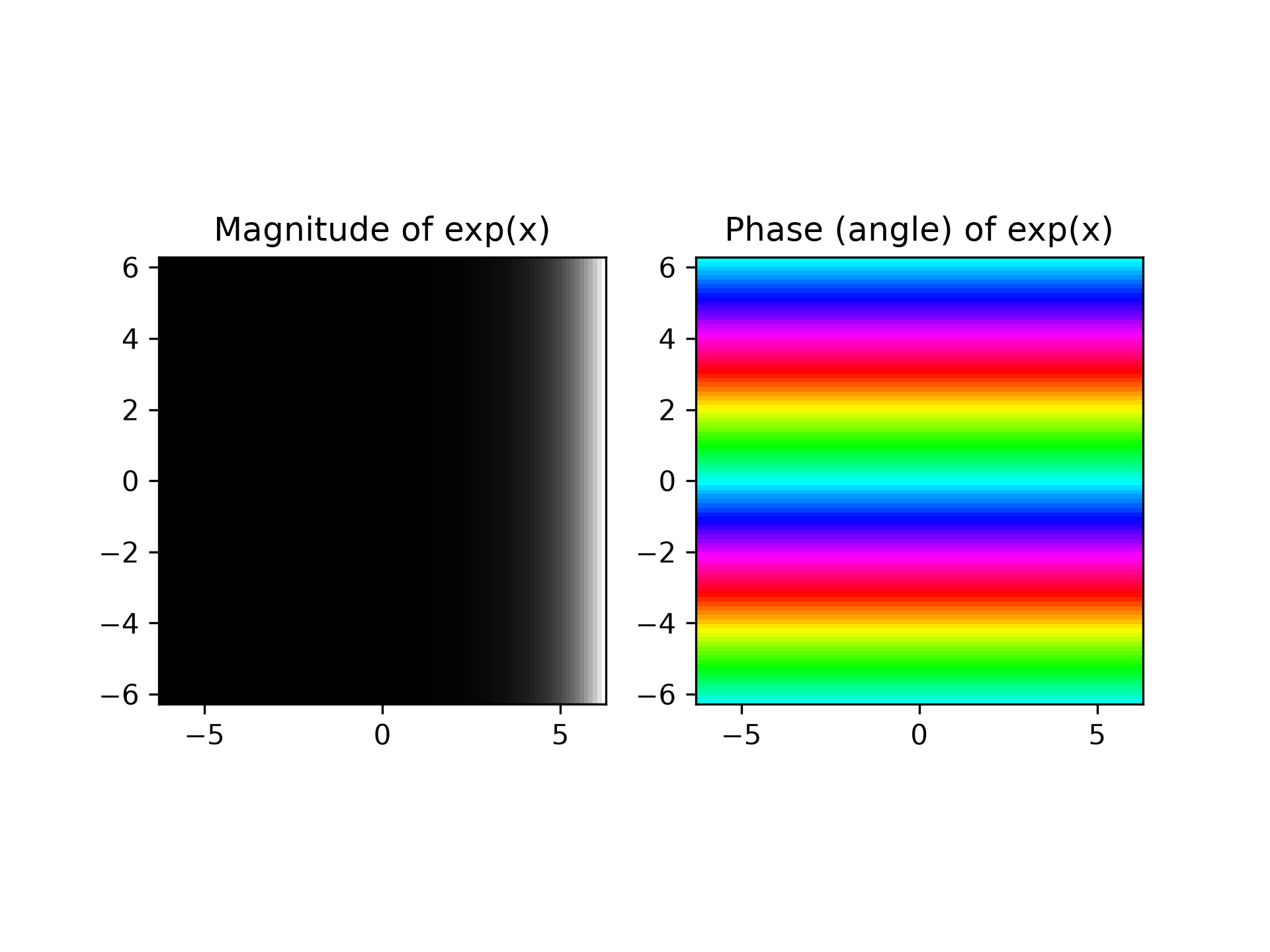
For complex arguments, x = a + ib, we can write . The first term, , is already known (it is the real argument, described above). The second term, , is , a function with magnitude 1 and a periodic phase.
Examples
Plot the magnitude and phase of ``exp(x)`` in the complex plane:import numpy as np
✓import matplotlib.pyplot as plt import numpy as np✓
x = np.linspace(-2*np.pi, 2*np.pi, 100)
xx = x + 1j * x[:, np.newaxis] # a + ib over complex plane
out = np.exp(xx)
✓
plt.subplot(121)
plt.imshow(np.abs(out),
           extent=[-2*np.pi, 2*np.pi, -2*np.pi, 2*np.pi], cmap='gray')
plt.title('Magnitude of exp(x)')
✗
Text(0.5, 1.0, 'Magnitude of exp(x)')
plt.subplot(122)
plt.imshow(np.angle(out),
           extent=[-2*np.pi, 2*np.pi, -2*np.pi, 2*np.pi], cmap='hsv')
plt.title('Phase (angle) of exp(x)')
✗
Text(0.5, 1.0, 'Phase (angle) of exp(x)')
plt.show()
✓
See also
Aliases
numpy.exp