bundles / numpy 2.5.0.dev0+git20251130.2de293a / numpy / random / RandomState / pareto
cython_function_or_method
numpy.random:RandomState.pareto
Signature
def pareto(a, size = None)Summary
Draw samples from a Pareto II or Lomax distribution with specified shape.
Extended Summary
The Lomax or Pareto II distribution is a shifted Pareto distribution. The classical Pareto distribution can be obtained from the Lomax distribution by adding 1 and multiplying by the scale parameter m (see Notes). The smallest value of the Lomax distribution is zero while for the classical Pareto distribution it is mu, where the standard Pareto distribution has location mu = 1. Lomax can also be considered as a simplified version of the Generalized Pareto distribution (available in SciPy), with the scale set to one and the location set to zero.
The Pareto distribution must be greater than zero, and is unbounded above. It is also known as the "80-20 rule". In this distribution, 80 percent of the weights are in the lowest 20 percent of the range, while the other 20 percent fill the remaining 80 percent of the range.
Parameters
a: float or array_like of floatsShape of the distribution. Must be positive.
size: int or tuple of ints, optionalOutput shape. If the given shape is, e.g.,
(m, n, k), thenm * n * ksamples are drawn. If size isNone(default), a single value is returned ifais a scalar. Otherwise,np.array(a).sizesamples are drawn.
Returns
out: ndarray or scalarDrawn samples from the parameterized Pareto distribution.
Notes
The probability density for the Pareto distribution is
where is the shape and the scale.
The Pareto distribution, named after the Italian economist Vilfredo Pareto, is a power law probability distribution useful in many real world problems. Outside the field of economics it is generally referred to as the Bradford distribution. Pareto developed the distribution to describe the distribution of wealth in an economy. It has also found use in insurance, web page access statistics, oil field sizes, and many other problems, including the download frequency for projects in Sourceforge [1]. It is one of the so-called "fat-tailed" distributions.
Examples
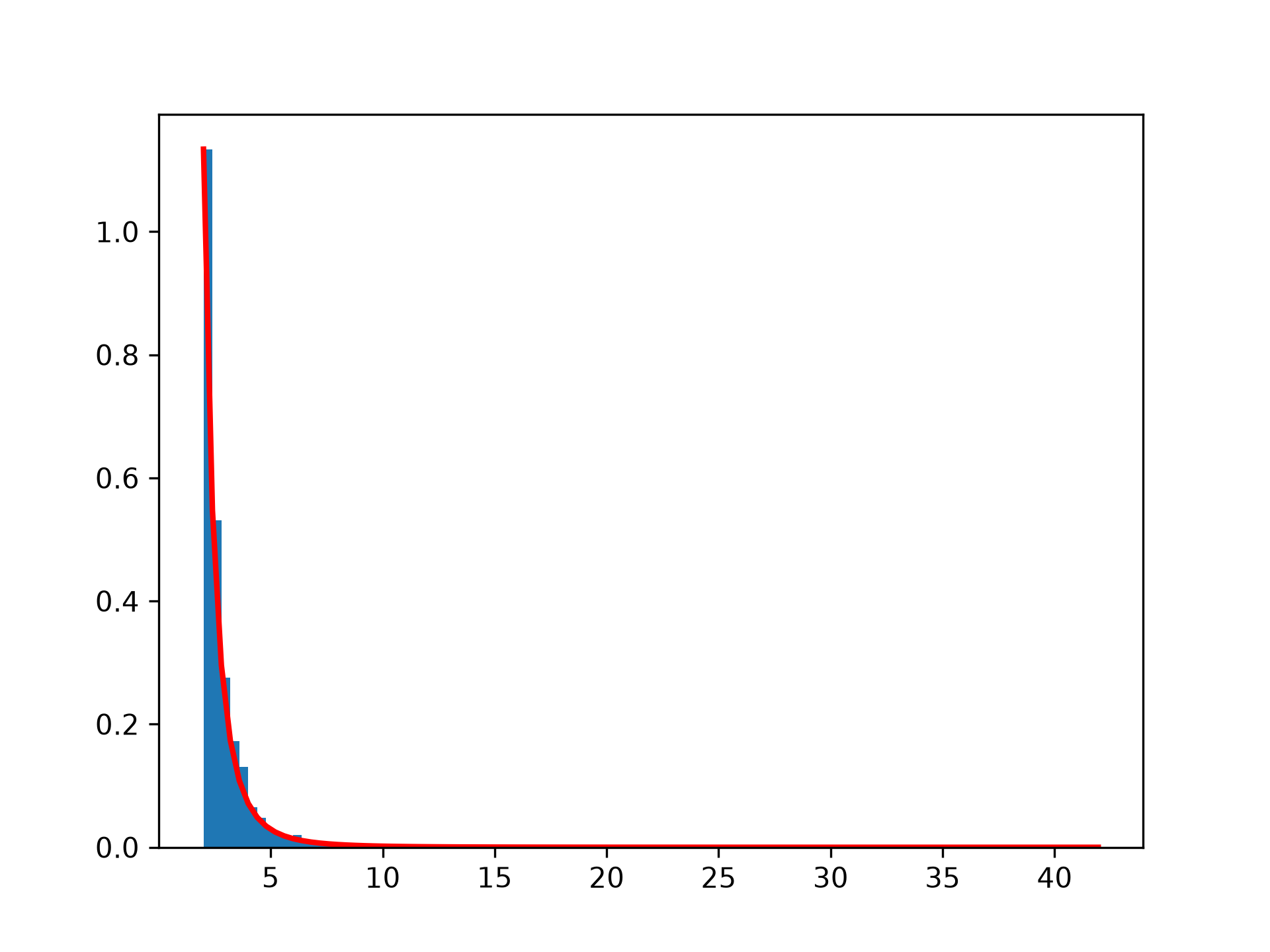
Draw samples from the distribution:a, m = 3., 2. # shape and mode s = (np.random.pareto(a, 1000) + 1) * m✓
import matplotlib.pyplot as plt
count, bins, _ = plt.hist(s, 100, density=True)
fit = a*m**a / bins**(a+1)
✓
plt.plot(bins, max(count)*fit/max(fit), linewidth=2, color='r')
✗[<matplotlib.lines.Line2D object at 0x7f2201a00440>]
plt.show()
✓
See also
- random.Generator.pareto
which should be used for new code.
- scipy.stats.genpareto
probability density function, distribution or cumulative density function, etc.
- scipy.stats.lomax
probability density function, distribution or cumulative density function, etc.
Aliases
numpy.random.paretonumpy.random.RandomState.pareto