bundles / scipy 1.17.1 / scipy / stats / _morestats / circstd
function
scipy.stats._morestats:circstd
source: /scipy/stats/_morestats.py:4380
Signature
def circstd(samples, high = 6.283185307179586, low = 0, axis = None, nan_policy = propagate, *, normalize = False, keepdims = False)Summary
Compute the circular standard deviation of a sample of angle observations.
Extended Summary
Given angle observations measured in radians, their circular standard deviation is defined by ([2], Eq. 2.3.11)
where is the imaginary unit and gives the length of the complex number . in the above expression is known as the mean resultant length.
Parameters
samples: array_likeInput array of angle observations. The value of a full angle is equal to
(high - low).high: float, optionalUpper boundary of the principal value of an angle. Default is
2*pi.low: float, optionalLower boundary of the principal value of an angle. Default is
0.normalize: boolean, optionalIf
False(the default), the return value is computed from the above formula with the input scaled by(2*pi)/(high-low)and the output scaled (back) by(high-low)/(2*pi). IfTrue, the output is not scaled and is returned directly.axis: int or None, default: NoneIf an int, the axis of the input along which to compute the statistic. The statistic of each axis-slice (e.g. row) of the input will appear in a corresponding element of the output. If
None, the input will be raveled before computing the statistic.nan_policy: {'propagate', 'omit', 'raise'}Defines how to handle input NaNs.
propagate: if a NaN is present in the axis slice (e.g. row) along which the statistic is computed, the corresponding entry of the output will be NaN.omit: NaNs will be omitted when performing the calculation. If insufficient data remains in the axis slice along which the statistic is computed, the corresponding entry of the output will be NaN.raise: if a NaN is present, aValueErrorwill be raised.
keepdims: bool, default: FalseIf this is set to True, the axes which are reduced are left in the result as dimensions with size one. With this option, the result will broadcast correctly against the input array.
Returns
circstd: floatCircular standard deviation, optionally normalized.
If the input array is empty,
np.nanis returned.
Notes
In the limit of small angles, the circular standard deviation is close to the 'linear' standard deviation if normalize is False.
Beginning in SciPy 1.9, np.matrix inputs (not recommended for new code) are converted to np.ndarray before the calculation is performed. In this case, the output will be a scalar or np.ndarray of appropriate shape rather than a 2D np.matrix. Similarly, while masked elements of masked arrays are ignored, the output will be a scalar or np.ndarray rather than a masked array with mask=False.
Array API Standard Support
circstd has experimental support for Python Array API Standard compatible backends in addition to NumPy. Please consider testing these features by setting an environment variable SCIPY_ARRAY_API=1 and providing CuPy, PyTorch, JAX, or Dask arrays as array arguments. The following combinations of backend and device (or other capability) are supported.
====================  ====================  ====================
Library               CPU                   GPU
====================  ====================  ====================
NumPy                 ✅                     n/a
CuPy                  n/a                   ✅
PyTorch               ✅                     ✅
JAX                   ✅                     ✅
Dask                  ✅                     n/a
====================  ====================  ====================
See
dev-arrayapifor more information.
Examples
import numpy as np
from scipy.stats import circstd
import matplotlib.pyplot as plt
samples_1 = np.array([0.072, -0.158, 0.077, 0.108, 0.286,
                      0.133, -0.473, -0.001, -0.348, 0.131])
samples_2 = np.array([0.111, -0.879, 0.078, 0.733, 0.421,
                      0.104, -0.136, -0.867,  0.012,  0.105])
circstd_1 = circstd(samples_1)
circstd_2 = circstd(samples_2)
✓
fig, (left, right) = plt.subplots(ncols=2)
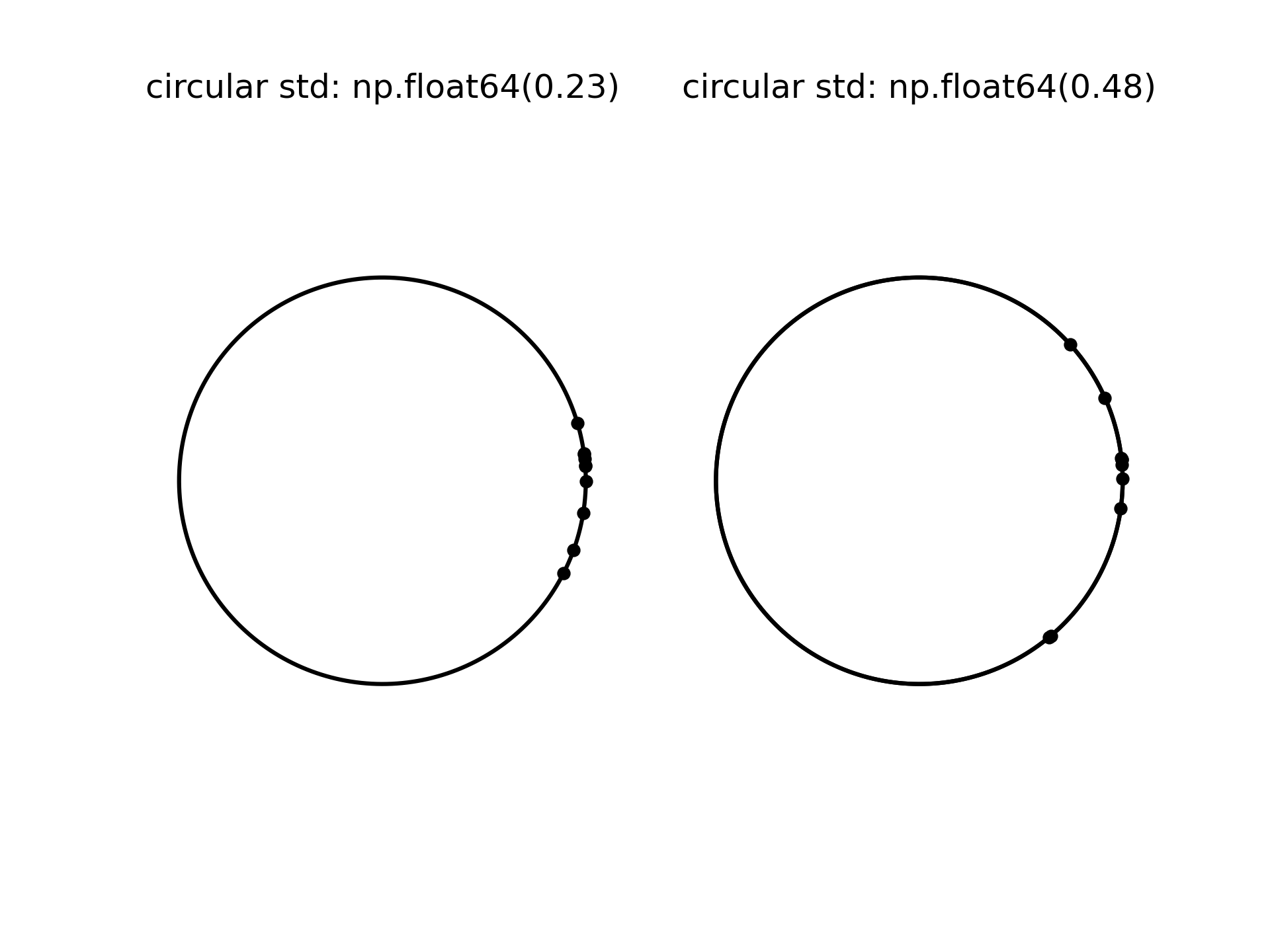
✓for image in (left, right): image.plot(np.cos(np.linspace(0, 2*np.pi, 500)), np.sin(np.linspace(0, 2*np.pi, 500)), c='k') image.axis('equal') image.axis('off') left.scatter(np.cos(samples_1), np.sin(samples_1), c='k', s=15) left.set_title(f"circular std: {np.round(circstd_1, 2)!r}") right.plot(np.cos(np.linspace(0, 2*np.pi, 500)), np.sin(np.linspace(0, 2*np.pi, 500)), c='k') right.scatter(np.cos(samples_2), np.sin(samples_2), c='k', s=15) right.set_title(f"circular std: {np.round(circstd_2, 2)!r}")✗
plt.show()
✓
See also
Aliases
scipy.stats.circstd