bundles / scipy latest / scipy / interpolate / _fitpack2 / LSQSphereBivariateSpline
class
scipy.interpolate._fitpack2:LSQSphereBivariateSpline
source: build-install/usr/lib/python3.14/site-packages/scipy/interpolate/_fitpack2.py:2364
Signature
class LSQSphereBivariateSpline(theta, phi, r, tt, tp, w = None, eps = 1e-16)Members
Summary
Weighted least-squares bivariate spline approximation in spherical coordinates.
Extended Summary
Determines a smoothing bicubic spline according to a given set of knots in the theta and phi directions.
Parameters
theta, phi, r: array_like1-D sequences of data points (order is not important). Coordinates must be given in radians. Theta must lie within the interval
[0, pi], and phi must lie within the interval[0, 2pi].tt, tp: array_likeStrictly ordered 1-D sequences of knots coordinates. Coordinates must satisfy
0 < tt[i] < pi,0 < tp[i] < 2*pi.w: array_like, optionalPositive 1-D sequence of weights, of the same length as
theta,phiandr.eps: float, optionalA threshold for determining the effective rank of an over-determined linear system of equations.
epsshould have a value within the open interval(0, 1), the default is 1e-16.
Notes
For more information, see the FITPACK_ site about this function.
Array API Standard Support
LSQSphereBivariateSpline is not in-scope for support of Python Array API Standard compatible backends other than NumPy.
See dev-arrayapi for more information.
Examples
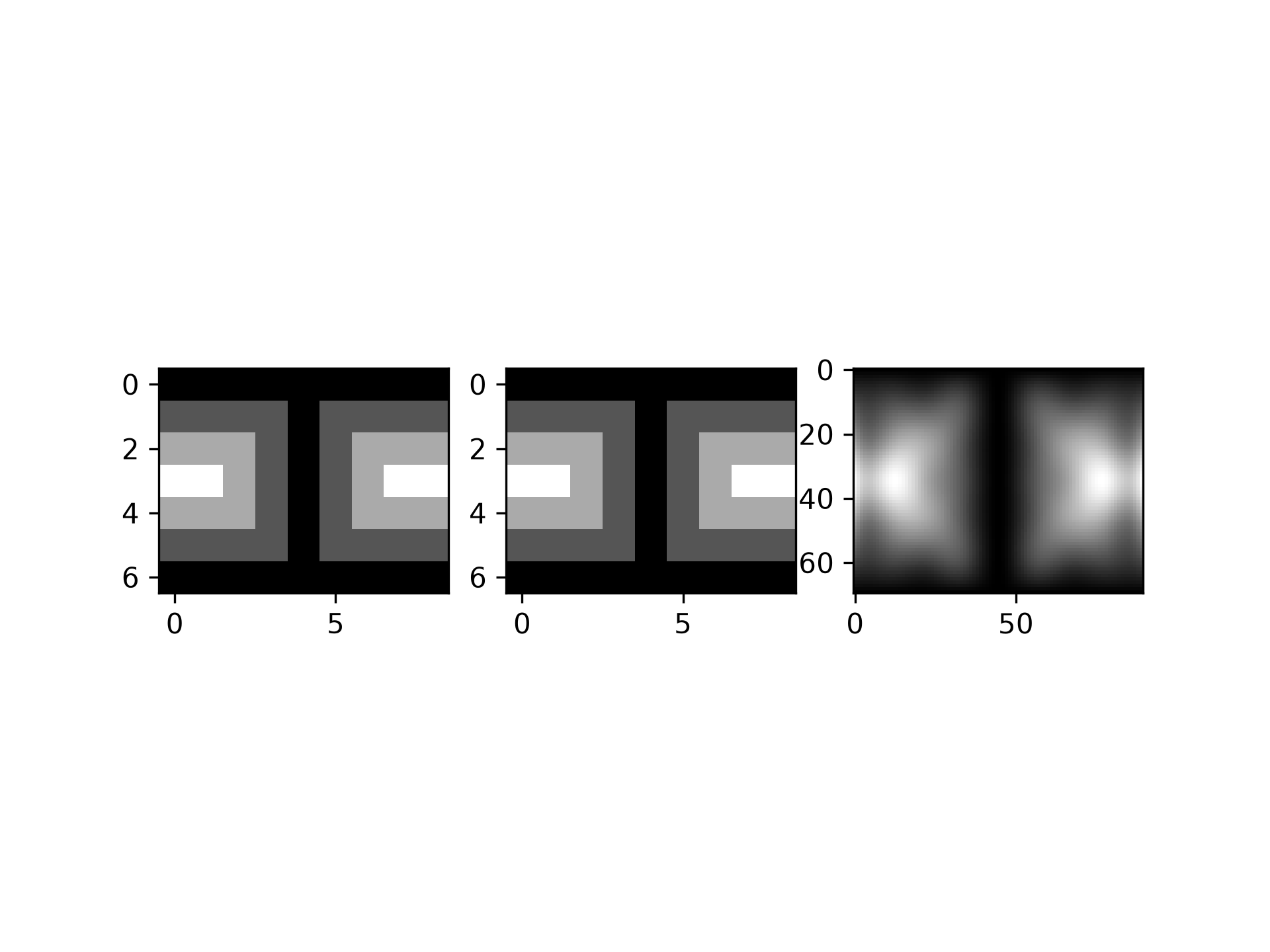
Suppose we have global data on a coarse grid (the input data does not have to be on a grid):from scipy.interpolate import LSQSphereBivariateSpline import numpy as np import matplotlib.pyplot as plt✓
theta = np.linspace(0, np.pi, num=7)
phi = np.linspace(0, 2*np.pi, num=9)
data = np.empty((theta.shape[0], phi.shape[0]))
data[:,0], data[0,:], data[-1,:] = 0., 0., 0.
data[1:-1,1], data[1:-1,-1] = 1., 1.
data[1,1:-1], data[-2,1:-1] = 1., 1.
data[2:-2,2], data[2:-2,-2] = 2., 2.
data[2,2:-2], data[-3,2:-2] = 2., 2.
data[3,3:-2] = 3.
data = np.roll(data, 4, 1)
✓
lats, lons = np.meshgrid(theta, phi)
knotst, knotsp = theta.copy(), phi.copy()
knotst[0] += .0001
knotst[-1] -= .0001
knotsp[0] += .0001
knotsp[-1] -= .0001
lut = LSQSphereBivariateSpline(lats.ravel(), lons.ravel(),
                               data.T.ravel(), knotst, knotsp)
✓
data_orig = lut(theta, phi)
✓fine_lats = np.linspace(0., np.pi, 70) fine_lons = np.linspace(0., 2*np.pi, 90) data_lsq = lut(fine_lats, fine_lons)✓
fig = plt.figure()
ax1 = fig.add_subplot(131)
✓
ax1.imshow(data, interpolation='nearest')
✗<matplotlib.image.AxesImage object at 0x7f3f60fd4190>
ax2 = fig.add_subplot(132)
✓ax2.imshow(data_orig, interpolation='nearest')
✗<matplotlib.image.AxesImage object at 0x7f3f60f5ce10>
ax3 = fig.add_subplot(133)
✓ax3.imshow(data_lsq, interpolation='nearest')
✗<matplotlib.image.AxesImage object at 0x7f3f68553610>
plt.show()
✓
See also
- BivariateSpline
a base class for bivariate splines.
- LSQBivariateSpline
a bivariate spline using weighted least-squares fitting
- RectBivariateSpline
a bivariate spline over a rectangular mesh.
- RectSphereBivariateSpline
a bivariate spline over a rectangular mesh on a sphere
- SmoothBivariateSpline
a smoothing bivariate spline through the given points
- SmoothSphereBivariateSpline
a smoothing bivariate spline in spherical coordinates
- UnivariateSpline
a smooth univariate spline to fit a given set of data points.
- bisplev
a function to evaluate a bivariate B-spline and its derivatives
- bisplrep
a function to find a bivariate B-spline representation of a surface
Aliases
scipy.interpolate.LSQSphereBivariateSpline