bundles / scipy latest / scipy / interpolate / _polyint / BarycentricInterpolator
class
scipy.interpolate._polyint:BarycentricInterpolator
source: build-install/usr/lib/python3.14/site-packages/scipy/interpolate/_polyint.py:559
Signature
class BarycentricInterpolator(xi, yi = None, axis = 0, *, wi = None, rng = None, random_state = None)Members
Summary
Barycentric (Lagrange with improved stability) interpolator (C∞ smooth).
Extended Summary
Constructs a polynomial that passes through a given set of points. Allows evaluation of the polynomial and all its derivatives, efficient changing of the y-values to be interpolated, and updating by adding more x- and y-values. For numerical stability, a barycentric representation is used rather than computing the coefficients of the polynomial directly.
Parameters
xi: array_like, shape (npoints, )1-D array of x-coordinates of the points the polynomial should pass through
yi: array_like, shape (..., npoints, ...), optionalN-D array of y-coordinates of the points the polynomial should pass through. If None, the y values will be supplied later via the
set_ymethod. The length ofyialong the interpolation axis must be equal to the length ofxi. Use theaxisparameter to select correct axis.axis: int, optionalAxis in the yi array corresponding to the x-coordinate values. Defaults to
axis=0.wi: array_like, optionalThe barycentric weights for the chosen interpolation points
xi. If absent or None, the weights will be computed fromxi(default). This allows for the reuse of the weightswiif several interpolants are being calculated using the same nodesxi, without re-computation. This also allows for computing the weights explicitly for some choices ofxi(see notes).rng: {None, int, `numpy.random.Generator`}, optionalIf
rngis passed by keyword, types other than numpy.random.Generator are passed to numpy.random.default_rng to instantiate aGenerator. Ifrngis already aGeneratorinstance, then the provided instance is used. Specifyrngfor repeatable interpolation.If this argument
random_stateis passed by keyword, legacy behavior for the argumentrandom_stateapplies:If
random_stateis None (or numpy.random), the numpy.random.RandomState singleton is used.If
random_stateis an int, a newRandomStateinstance is used, seeded withrandom_state.If
random_stateis already aGeneratororRandomStateinstance then that instance is used.
Notes
This method is a variant of Lagrange polynomial interpolation [1] based on [2]. Instead of using Lagrange's or Newton's formula, the polynomial is represented by the barycentric formula
where are the barycentric weights computed with the general formula
This is the same barycentric form used by AAA and FloaterHormannInterpolator. However, in contrast, the weights are defined such that is a polynomial rather than a rational function.
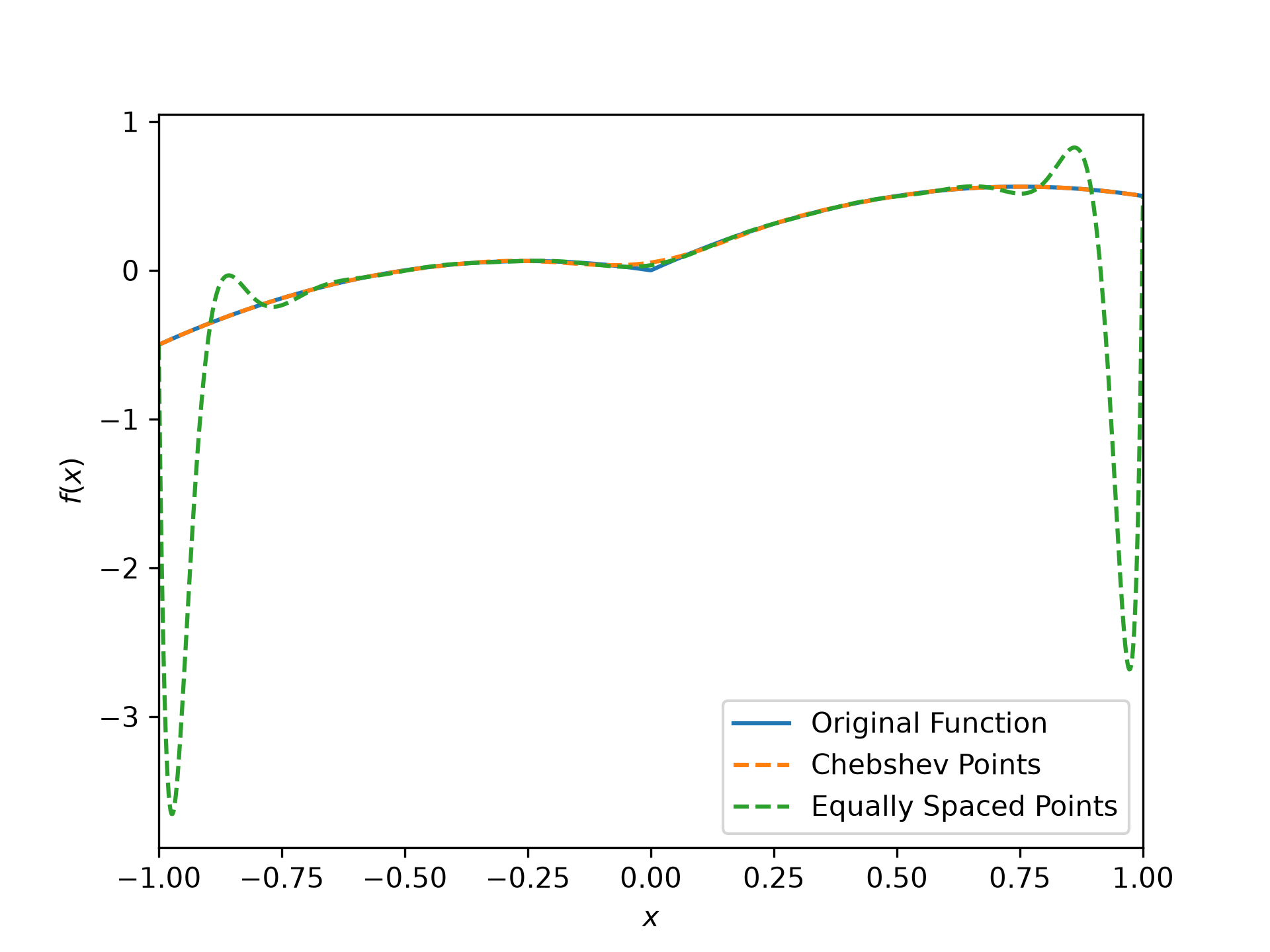
The barycentric representation avoids many of the problems associated with polynomial interpolation caused by floating-point arithmetic. However, it does not avoid issues that are intrinsic to polynomial interpolation. Namely, if the x-coordinates are equally spaced, then the weights can be computed explicitly using the formula from [2]
where is the number of x-coordinates. As noted in [2], this means that for large the weights vary by exponentially large factors, leading to the Runge phenomenon.
To avoid this ill-conditioning, the x-coordinates should be clustered at the endpoints of the interval. An excellent choice of points on the interval are Chebyshev points of the second kind
in which case the weights can be computed explicitly as
See [2] for more information. Note that for large , computing the weights explicitly (see examples) will be faster than the generic formula.
Examples
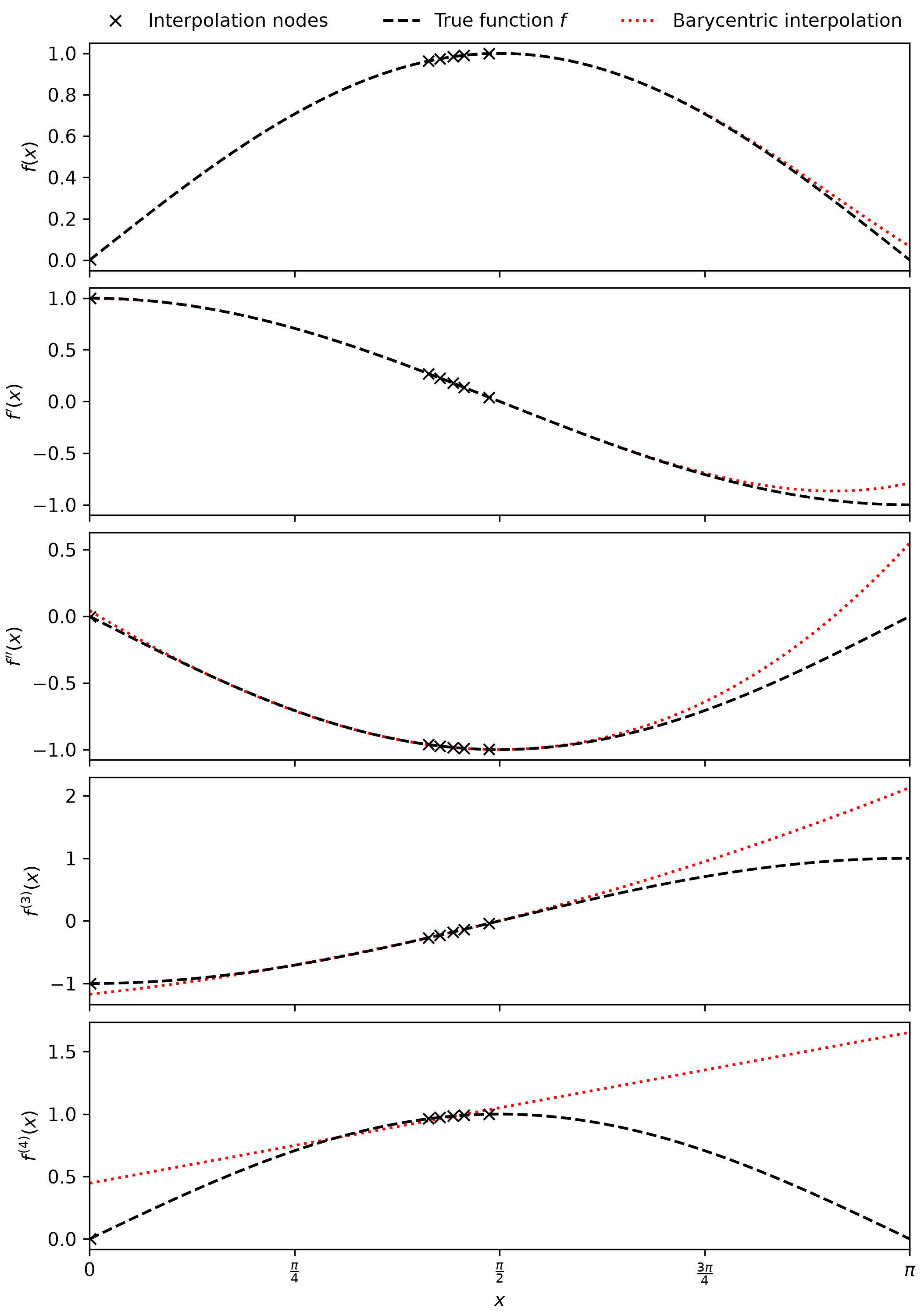
To produce a quintic barycentric interpolant approximating the function :math:`\sin x`, and its first four derivatives, using six randomly-spaced nodes in :math:`(0, \pi/2)`:import numpy as np import matplotlib.pyplot as plt from scipy.interpolate import BarycentricInterpolator rng = np.random.default_rng() xi = rng.random(6) * np.pi/2 f, f_d1, f_d2, f_d3, f_d4 = np.sin, np.cos, lambda x: -np.sin(x), lambda x: -np.cos(x), np.sin P = BarycentricInterpolator(xi, f(xi), random_state=rng) fig, axs = plt.subplots(5, 1, sharex=True, layout='constrained', figsize=(7,10)) x = np.linspace(0, np.pi, 100)✓
axs[0].plot(x, P(x), 'r:', x, f(x), 'k--', xi, f(xi), 'xk')
axs[1].plot(x, P.derivative(x), 'r:', x, f_d1(x), 'k--', xi, f_d1(xi), 'xk')
axs[2].plot(x, P.derivative(x, 2), 'r:', x, f_d2(x), 'k--', xi, f_d2(xi), 'xk')
axs[3].plot(x, P.derivative(x, 3), 'r:', x, f_d3(x), 'k--', xi, f_d3(xi), 'xk')
axs[4].plot(x, P.derivative(x, 4), 'r:', x, f_d4(x), 'k--', xi, f_d4(xi), 'xk')
axs[0].set_xlim(0, np.pi)
axs[4].set_xlabel(r"$x$")
axs[4].set_xticks([i * np.pi / 4 for i in range(5)],
                  ["0", r"$\frac{\pi}{4}$", r"$\frac{\pi}{2}$", r"$\frac{3\pi}{4}$", r"$\pi$"])
for ax, label in zip(axs, ("$f(x)$", "$f'(x)$", "$f''(x)$", "$f^{(3)}(x)$", "$f^{(4)}(x)$")):
    ax.set_ylabel(label)
✗
Text(0, 0.5, '$f(x)$')
Text(0, 0.5, "$f'(x)$")
Text(0, 0.5, "$f''(x)$")
Text(0, 0.5, '$f^{(3)}(x)$')
Text(0, 0.5, '$f^{(4)}(x)$')
labels = ['Interpolation nodes', 'True function $f$', 'Barycentric interpolation']
✓axs[0].legend(axs[0].get_lines()[::-1], labels, bbox_to_anchor=(0., 1.02, 1., .102), loc='lower left', ncols=3, mode="expand", borderaxespad=0., frameon=False)✗
<matplotlib.legend.Legend object at 0x7f3f69733a10>
plt.show()
✓
n = 20
def f(x): return np.abs(x) + 0.5*x - x**2
i = np.arange(n)
x_cheb = np.cos(i*np.pi/(n - 1))  # Chebyshev points on [-1, 1]
w_i_cheb = (-1.)**i  # Explicit formula for weights of Chebyshev points
w_i_cheb[[0, -1]] /= 2
p_cheb = BarycentricInterpolator(x_cheb, f(x_cheb), wi=w_i_cheb)
x_equi = np.linspace(-1, 1, n)
p_equi = BarycentricInterpolator(x_equi, f(x_equi))
xx = np.linspace(-1, 1, 1000)
fig, ax = plt.subplots()
✓
ax.plot(xx, f(xx), label="Original Function")
ax.plot(xx, p_cheb(xx), "--", label="Chebshev Points")
ax.plot(xx, p_equi(xx), "--", label="Equally Spaced Points")
ax.set(xlabel="$x$", ylabel="$f(x)$", xlim=[-1, 1])
ax.legend()
✗
<matplotlib.legend.Legend object at 0x7f3f687da900>
plt.show()
✓
Aliases
scipy.interpolate.BarycentricInterpolator