bundles / scipy latest / scipy / signal / _short_time_fft / ShortTimeFFT / from_win_equals_dual
classmethod
scipy.signal._short_time_fft:ShortTimeFFT.from_win_equals_dual
source: build-install/usr/lib/python3.14/site-packages/scipy/signal/_short_time_fft.py:620
Summary
Create instance where the window and its dual are equal up to a scaling factor.
Extended Summary
An instance is created were window and dual window are equal as well as being closest to the parameter desired_win in the least-squares sense, i.e., minimizing abs(win-desired_win)**2. Hence, win has the same length as desired_win. Then a scaling factor is applied according to the scale_to parameter.
All other parameters have the identical meaning as in the initializer.
To be able to calculate a valid window, desired_win needs to have a valid dual STFT window for the given hop interval. If this is not the case, a ValueError is raised.
Parameters
desired_win: np.ndarrayA real-valued or complex-valued 1d array containing the sample of the desired window.
hop: intThe increment in samples, by which the window is shifted in each step.
fs: floatSampling frequency of input signal and window. Its relation to the sampling interval
TisT = 1 / fs.fft_mode: 'twosided', 'centered', 'onesided', 'onesided2X'Mode of FFT to be used (default 'onesided'). See property fft_mode for details.
mfft: int | NoneLength of the FFT used, if a zero padded FFT is desired. If
None(default), the length of the windowwinis used.scale_to: 'magnitude' | 'psd' | 'unitary' | NoneIf not
None(default) the window function is scaled, so each STFT column represents either a 'magnitude' or a power spectral density ('psd') spectrum, Alternatively, the STFT can be scaled to a`unitary` mapping, i.e., dividing the window bynp.sqrt(mfft)and multiplying the dual window by the same amount.phase_shift: int | NoneIf set, add a linear phase phase_shift / mfft *
fto each frequencyf. The default value of 0 ensures that there is no phase shift on the zeroth slice (in which t=0 is centered). See property phase_shift for more details.
Notes
The set of all possible windows with identical dual is defined by the set of linear constraints of Eq. eq_STFT_AllDualWinsCond in the tutorial_stft section of the user_guide. There it is also derived that ShortTimeFFT.dual_win == ShortTimeFFT.m_pts * ShortTimeFFT.win needs to hold for an STFT to be a unitary mapping.
A unitary mapping preserves the value of the scalar product, i.e.,
with being the STFT of . Hence, the energy of a signal is also preserved. This is also illustrated in the example below.
The reason of distinguishing between no scaling (i.e., parameter scale_to is None) and unitary scaling (i.e., scale_to = 'unitary') is due to the utilized FFT function not being unitary (i.e., using the default value 'backward' for the fft parameter norm).
Examples
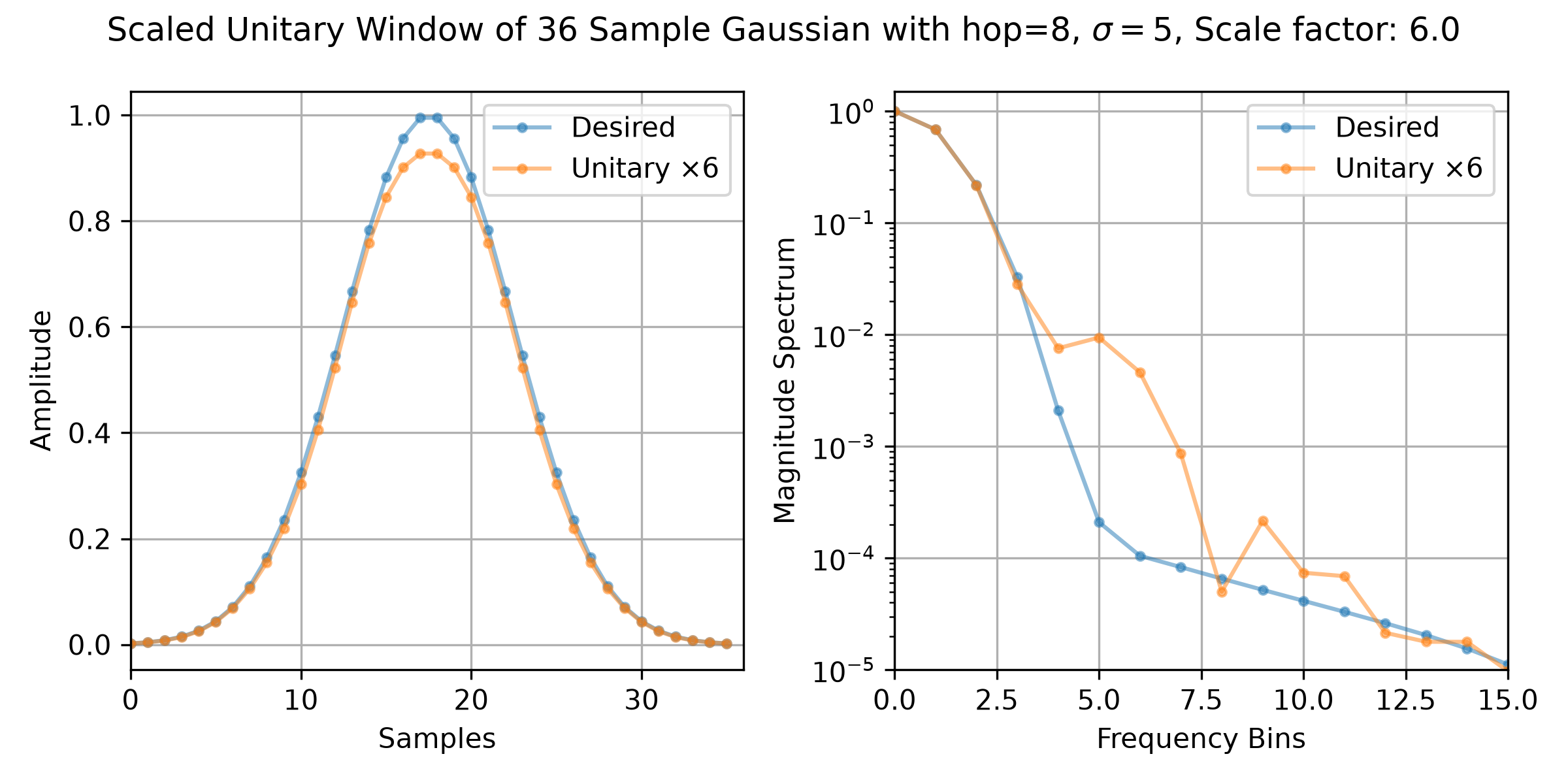
The following example shows that an STFT can be indeed unitary:import matplotlib.pyplot as plt import numpy as np from scipy.signal import ShortTimeFFT, windows m, hop, std = 36, 8, 5 desired_win = windows.gaussian(m, std, sym=True) SFT = ShortTimeFFT.from_win_equals_dual(desired_win, hop, fs=1/m, fft_mode='twosided', scale_to='unitary') np.allclose(SFT.dual_win, SFT.win * SFT.m_num) # check if STFT is unitary x1, x2 = np.tile([-1, -1, 1, 1], 5), np.tile([1, -1, -1, 1], 5)✓
np.sum(x1*x2) # scalar product is zero -> orthogonal signals
np.sum(x1**2)  # scalar product of x1 with itself
✗
np.int64(20)
Sx11, Sx12 = SFT.spectrogram(x1), SFT.spectrogram(x1, x2)
✓np.sum(Sx12) # STFT scalar product is also zero np.sum(Sx11) # == np.sum(x1**2)✗
np.float64(20.0)
fg1, (ax11, ax12) = plt.subplots(1, 2, tight_layout=True, figsize=(8, 4))
s_fac = np.sqrt(SFT.mfft)
_ = fg1.suptitle(f"Scaled Unitary Window of {m} Sample Gaussian with " +
                 rf"{hop=}, $\sigma={std}$, Scale factor: {s_fac}")
✓
ax11.set(ylabel="Amplitude", xlabel="Samples", xlim=(0, m))
ax12.set(xlabel="Frequency Bins", ylabel="Magnitude Spectrum",
         xlim=(0, 15), ylim=(1e-5, 1.5))
✗
[Text(0.5, 0, 'Frequency Bins'), Text(0, 0.5, 'Magnitude Spectrum'), (0.0, 15.0), (1e-05, 1.5)]
u_win_str = rf"Unitary $\times{s_fac:g}$"
✓for x_, n_ in zip((desired_win, SFT.win*s_fac), ('Desired', u_win_str)): ax11.plot(x_, '.-', alpha=0.5, label=n_) X_ = np.fft.rfft(x_) / np.sum(abs(x_)) ax12.semilogy(abs(X_), '.-', alpha=0.5, label=n_) for ax_ in (ax11, ax12): ax_.grid(True) ax_.legend()✗
<matplotlib.legend.Legend object at 0x7f3f592f0830>
<matplotlib.legend.Legend object at 0x7f3f592f1160>
plt.show()
✓
See also
- ShortTimeFFT
Class this property belongs to.
- ShortTimeFFT.spectrogram
Calculate squared STFTs
- closest_STFT_dual_window
Calculate the STFT dual window of a given window closest to a desired dual window.
Aliases
scipy.signal.ShortTimeFFT.from_win_equals_dual