bundles / scipy latest / scipy / signal / _spectral_py / lombscargle
function
scipy.signal._spectral_py:lombscargle
source: build-install/usr/lib/python3.14/site-packages/scipy/signal/_spectral_py.py:19
Signature
def lombscargle(x: npt.ArrayLike, y: npt.ArrayLike, freqs: npt.ArrayLike, *, normalize: bool | Literal['power', 'normalize', 'amplitude'] = False, weights: npt.NDArray | None = None, floating_mean: bool = False) → npt.NDArraySummary
Compute the generalized Lomb-Scargle periodogram.
Extended Summary
The Lomb-Scargle periodogram was developed by Lomb [1] and further extended by Scargle [2] to find, and test the significance of weak periodic signals with uneven temporal sampling. The algorithm used here is based on a weighted least-squares fit of the form y(ω) = a*cos(ω*x) + b*sin(ω*x) + c, where the fit is calculated for each frequency independently. This algorithm was developed by Zechmeister and Kürster which improves the Lomb-Scargle periodogram by enabling the weighting of individual samples and calculating an unknown y offset (also called a "floating-mean" model) [3]. For more details, and practical considerations, see the excellent reference on the Lomb-Scargle periodogram [4].
When normalize is False (or "power") (default) the computed periodogram is unnormalized, it takes the value (A**2) * N/4 for a harmonic signal with amplitude A for sufficiently large N. Where N is the length of x or y.
When normalize is True (or "normalize") the computed periodogram is normalized by the residuals of the data around a constant reference model (at zero).
When normalize is "amplitude" the computed periodogram is the complex representation of the amplitude and phase.
Input arrays should be 1-D of a real floating data type, which are converted into float64 arrays before processing.
Parameters
x: array_likeSample times.
y: array_likeMeasurement values. Values are assumed to have a baseline of
y = 0. If there is a possibility of a y offset, it is recommended to setfloating_meanto True.freqs: array_likeAngular frequencies (e.g., having unit rad/s=2π/s for
xhaving unit s) for output periodogram. Frequencies are normally >= 0, as any peak at-freqwill also exist at+freq.normalize: bool | str, optionalCompute normalized or complex (amplitude + phase) periodogram. Valid options are:
False/"power",True/"normalize", or"amplitude".weights: array_like, optionalWeights for each sample. Weights must be nonnegative.
floating_mean: bool, optionalDetermines a y offset for each frequency independently, if True. Else the y offset is assumed to be
0.
Returns
pgram: array_likeLomb-Scargle periodogram.
Raises
: ValueErrorIf any of the input arrays x, y, freqs, or weights are not 1D, or if any are zero length. Or, if the input arrays x, y, and weights do not have the same shape as each other.
: ValueErrorIf any weight is < 0, or the sum of the weights is <= 0.
: ValueErrorIf the normalize parameter is not one of the allowed options.
Notes
The algorithm used will not automatically account for any unknown y offset, unless floating_mean is True. Therefore, for most use cases, if there is a possibility of a y offset, it is recommended to set floating_mean to True. Furthermore, floating_mean accounts for sample weights, and will also correct for any bias due to consistently missing observations at peaks and/or troughs.
The legacy concept of "pre-centering" entails removing the mean from parameter y before processing, i.e., passing y - y.mean() instead of setting the parameter floating_mean to True.
When the normalize parameter is "amplitude", for any frequency in freqs that is below (2*pi)/(x.max() - x.min()), the predicted amplitude will tend towards infinity. The concept of a "Nyquist frequency" limit (see Nyquist-Shannon sampling theorem) is not generally applicable to unevenly sampled data. Therefore, with unevenly sampled data, valid frequencies in freqs can often be much higher than expected for those familiar with methods like FFT.
Examples
import numpy as np
rng = np.random.default_rng()
✓
A = 2.  # amplitude
c = 2.  # offset
w0 = 1.  # rad/sec
nin = 150
nout = 1002
✓
x = rng.uniform(0, 10*np.pi, nin)
✓y = A * np.cos(w0*x) + c
✓w = np.linspace(0.25, 10, nout)
✓from scipy.signal import lombscargle pgram_power = lombscargle(x, y, w, normalize=False) pgram_norm = lombscargle(x, y, w, normalize=True) pgram_amp = lombscargle(x, y, w, normalize='amplitude') pgram_power_f = lombscargle(x, y, w, normalize=False, floating_mean=True) pgram_norm_f = lombscargle(x, y, w, normalize=True, floating_mean=True) pgram_amp_f = lombscargle(x, y, w, normalize='amplitude', floating_mean=True)✓
import matplotlib.pyplot as plt
fig, (ax_t, ax_p, ax_n, ax_a) = plt.subplots(4, 1, figsize=(5, 6))
✓
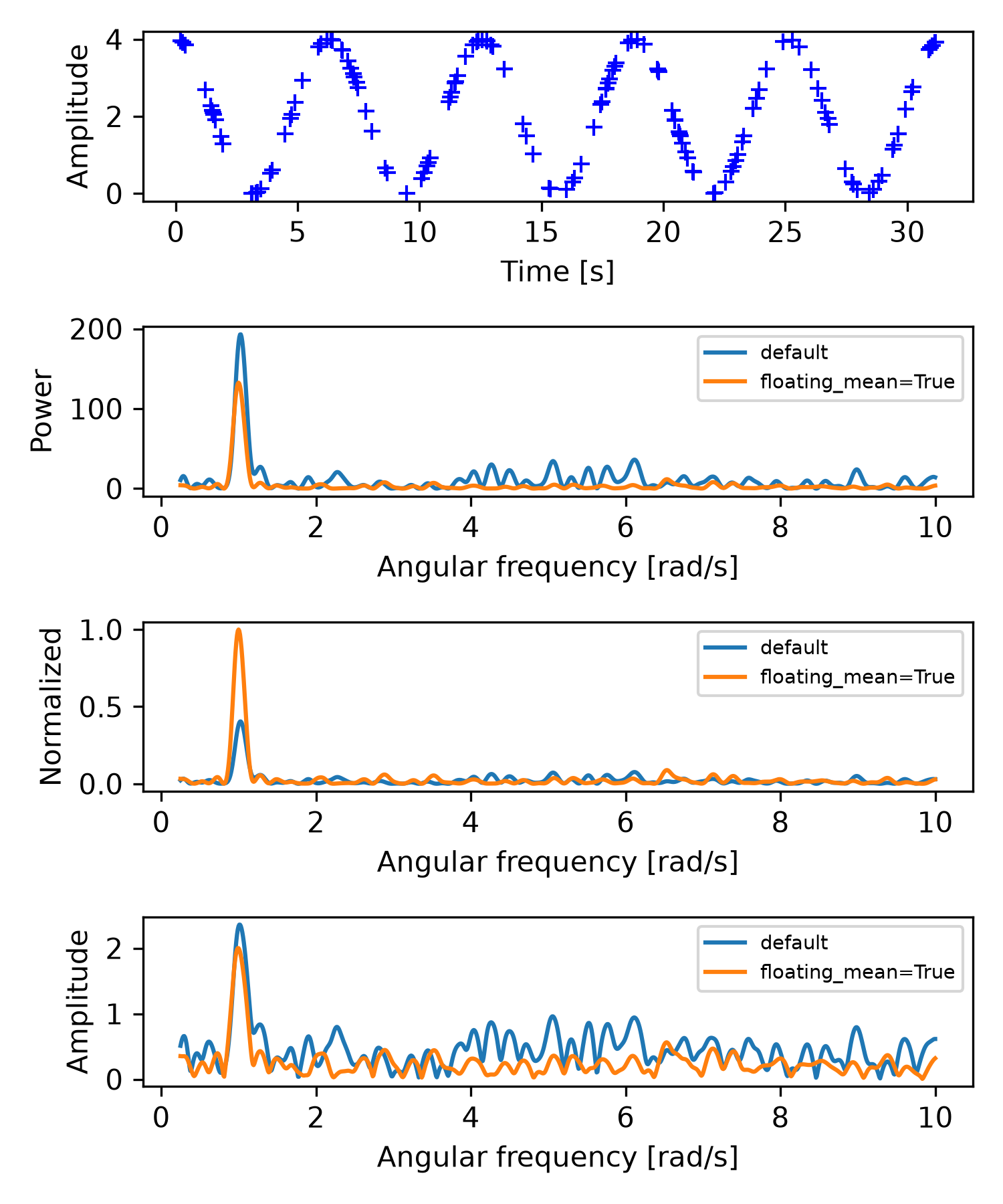
ax_t.plot(x, y, 'b+')
ax_t.set_xlabel('Time [s]')
ax_t.set_ylabel('Amplitude')
✗
Text(0, 0.5, 'Amplitude')Then plot the periodogram for each of the normalize options, as well as with and without floating_mean=True:
ax_p.plot(w, pgram_power, label='default')
ax_p.plot(w, pgram_power_f, label='floating_mean=True')
ax_p.set_xlabel('Angular frequency [rad/s]')
ax_p.set_ylabel('Power')
ax_p.legend(prop={'size': 7})
ax_n.plot(w, pgram_norm, label='default')
ax_n.plot(w, pgram_norm_f, label='floating_mean=True')
ax_n.set_xlabel('Angular frequency [rad/s]')
ax_n.set_ylabel('Normalized')
ax_n.legend(prop={'size': 7})
ax_a.plot(w, np.abs(pgram_amp), label='default')
ax_a.plot(w, np.abs(pgram_amp_f), label='floating_mean=True')
ax_a.set_xlabel('Angular frequency [rad/s]')
ax_a.set_ylabel('Amplitude')
ax_a.legend(prop={'size': 7})
✗
<matplotlib.legend.Legend object at 0x7f3f69161fd0>
plt.tight_layout()
plt.show()
✓
See also
- csd
Cross spectral density by Welch's method
- periodogram
Power spectral density using a periodogram
- welch
Power spectral density by Welch's method
Aliases
scipy.signal.lombscargle