bundles / numpy 2.4.4 / numpy / random / RandomState / gamma
cython_function_or_method
numpy.random:RandomState.gamma
Signature
def gamma ( shape , scale = 1.0 , size = None ) Summary
Draw samples from a Gamma distribution.
Extended Summary
Samples are drawn from a Gamma distribution with specified parameters, shape (sometimes designated "k") and scale (sometimes designated "theta"), where both parameters are > 0.
Parameters
shape: float or array_like of floatsThe shape of the gamma distribution. Must be non-negative.
scale: float or array_like of floats, optionalThe scale of the gamma distribution. Must be non-negative. Default is equal to 1.
size: int or tuple of ints, optionalOutput shape. If the given shape is, e.g.,
(m, n, k), thenm * n * ksamples are drawn. If size isNone(default), a single value is returned ifshapeandscaleare both scalars. Otherwise,np.broadcast(shape, scale).sizesamples are drawn.
Returns
out: ndarray or scalarDrawn samples from the parameterized gamma distribution.
Notes
The probability density for the Gamma distribution is
where is the shape and the scale, and is the Gamma function.
The Gamma distribution is often used to model the times to failure of electronic components, and arises naturally in processes for which the waiting times between Poisson distributed events are relevant.
Examples
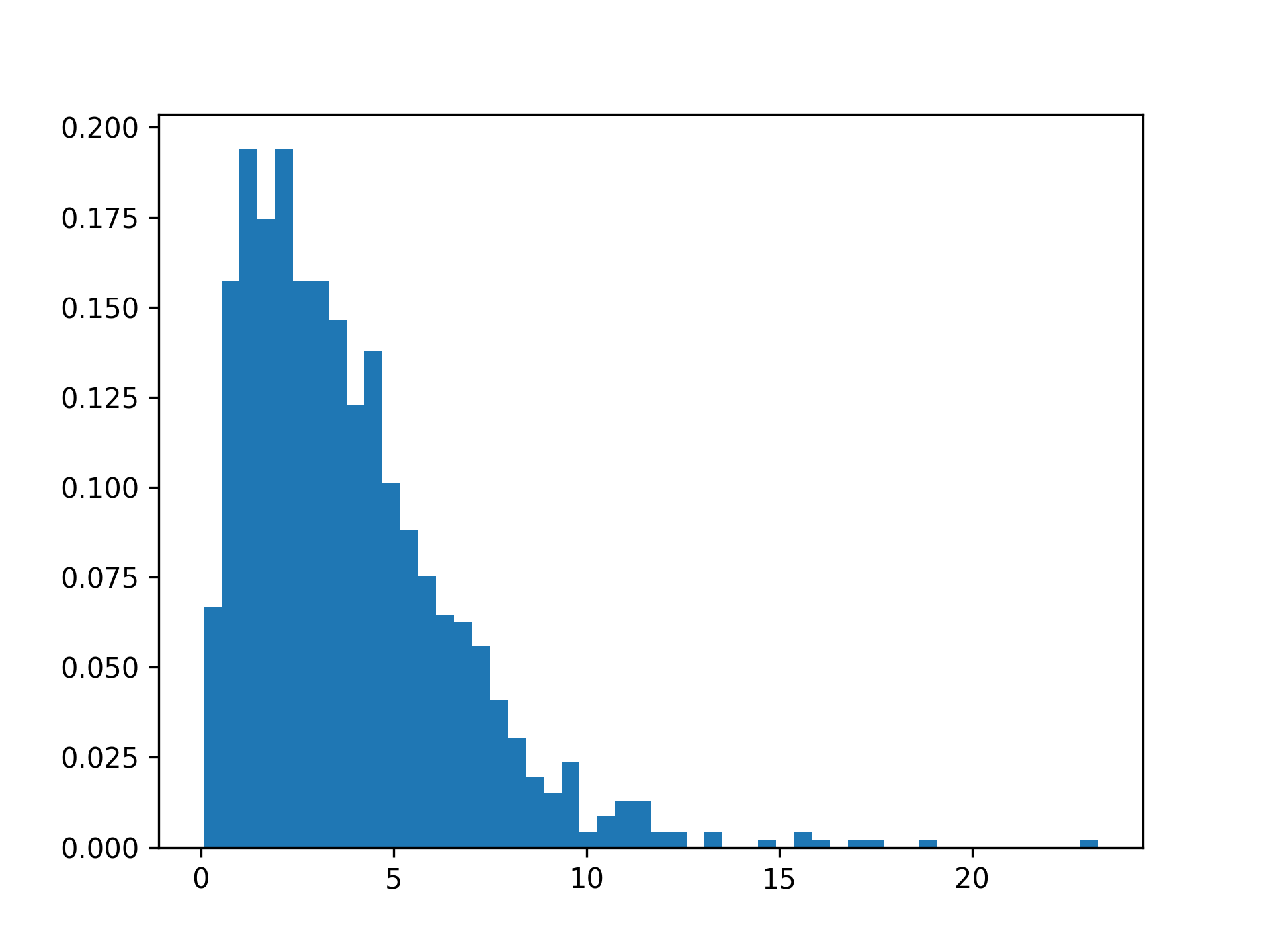
Draw samples from the distribution:shape, scale = 2., 2. # mean=4, std=2*sqrt(2) s = np.random.gamma(shape, scale, 1000)✓
import matplotlib.pyplot as plt
count, bins, ignored = plt.hist(s, 50, density=True)
plt.show()
✓
See also
- random.Generator.gamma
which should be used for new code.
- scipy.stats.gamma
probability density function, distribution or cumulative density function, etc.
Aliases
-
numpy.random.gamma -
numpy.random.RandomState.gamma