bundles / numpy 2.4.4 / numpy / random / RandomState / uniform
cython_function_or_method
numpy.random:RandomState.uniform
Signature
def uniform(low = 0.0, high = 1.0, size = None)Summary
Draw samples from a uniform distribution.
Extended Summary
Samples are uniformly distributed over the half-open interval [low, high) (includes low, but excludes high). In other words, any value within the given interval is equally likely to be drawn by uniform.
Parameters
low: float or array_like of floats, optionalLower boundary of the output interval. All values generated will be greater than or equal to low. The default value is 0.
high: float or array_like of floatsUpper boundary of the output interval. All values generated will be less than or equal to high. The high limit may be included in the returned array of floats due to floating-point rounding in the equation
low + (high-low) * random_sample(). The default value is 1.0.size: int or tuple of ints, optionalOutput shape. If the given shape is, e.g.,
(m, n, k), thenm * n * ksamples are drawn. If size isNone(default), a single value is returned iflowandhighare both scalars. Otherwise,np.broadcast(low, high).sizesamples are drawn.
Returns
out: ndarray or scalarDrawn samples from the parameterized uniform distribution.
Notes
The probability density function of the uniform distribution is
anywhere within the interval [a, b), and zero elsewhere.
When high == low, values of low will be returned. If high < low, the results are officially undefined and may eventually raise an error, i.e. do not rely on this function to behave when passed arguments satisfying that inequality condition. The high limit may be included in the returned array of floats due to floating-point rounding in the equation low + (high-low) * random_sample(). For example:
>>> x = np.float32(5*0.99999999)
>>> x
np.float32(5.0)
Examples
Draw samples from the distribution:s = np.random.uniform(-1,0,1000)
✓np.all(s >= -1) np.all(s < 0)✗
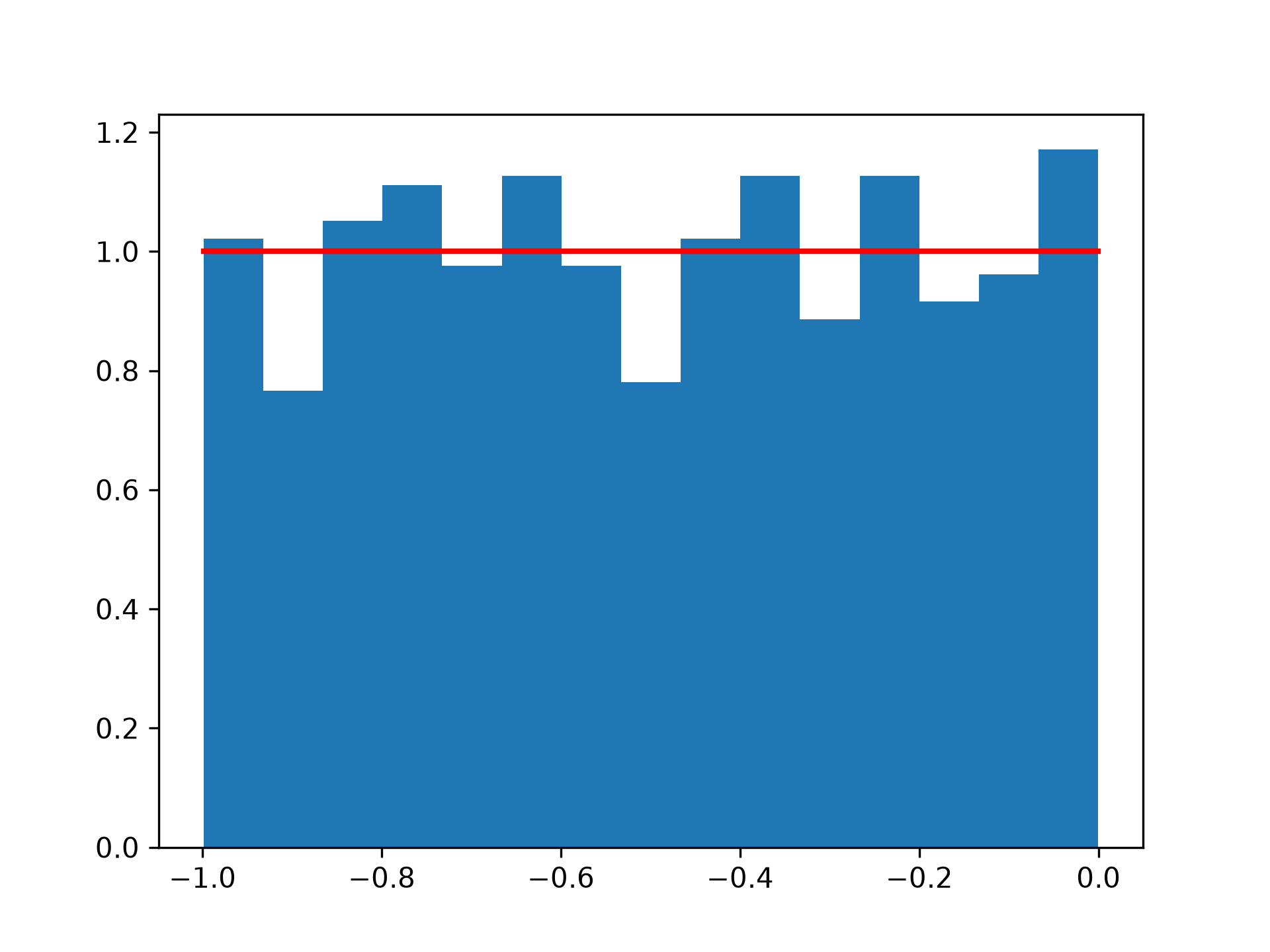
np.True_Display the histogram of the samples, along with the probability density function:
import matplotlib.pyplot as plt
count, bins, ignored = plt.hist(s, 15, density=True)
✓
plt.plot(bins, np.ones_like(bins), linewidth=2, color='r')
✗[<matplotlib.lines.Line2D object at 0x7fe97ee70050>]
plt.show()
✓
See also
- rand
Convenience function that accepts dimensions as input, e.g.,
rand(2,2)would generate a 2-by-2 array of floats, uniformly distributed over[0, 1).- randint
Discrete uniform distribution, yielding integers.
- random
Alias for
random_sample.- random.Generator.uniform
which should be used for new code.
- random_integers
Discrete uniform distribution over the closed interval
[low, high].- random_sample
Floats uniformly distributed over
[0, 1).
Aliases
numpy.random.uniformnumpy.random.RandomState.uniform