bundles / numpy 2.4.4 / numpy / random / RandomState / wald
cython_function_or_method
numpy.random:RandomState.wald
Signature
def wald ( mean , scale , size = None ) Summary
Draw samples from a Wald, or inverse Gaussian, distribution.
Extended Summary
As the scale approaches infinity, the distribution becomes more like a Gaussian. Some references claim that the Wald is an inverse Gaussian with mean equal to 1, but this is by no means universal.
The inverse Gaussian distribution was first studied in relationship to Brownian motion. In 1956 M.C.K. Tweedie used the name inverse Gaussian because there is an inverse relationship between the time to cover a unit distance and distance covered in unit time.
Parameters
mean: float or array_like of floatsDistribution mean, must be > 0.
scale: float or array_like of floatsScale parameter, must be > 0.
size: int or tuple of ints, optionalOutput shape. If the given shape is, e.g.,
(m, n, k), thenm * n * ksamples are drawn. If size isNone(default), a single value is returned ifmeanandscaleare both scalars. Otherwise,np.broadcast(mean, scale).sizesamples are drawn.
Returns
out: ndarray or scalarDrawn samples from the parameterized Wald distribution.
Notes
The probability density function for the Wald distribution is
As noted above the inverse Gaussian distribution first arise from attempts to model Brownian motion. It is also a competitor to the Weibull for use in reliability modeling and modeling stock returns and interest rate processes.
Examples
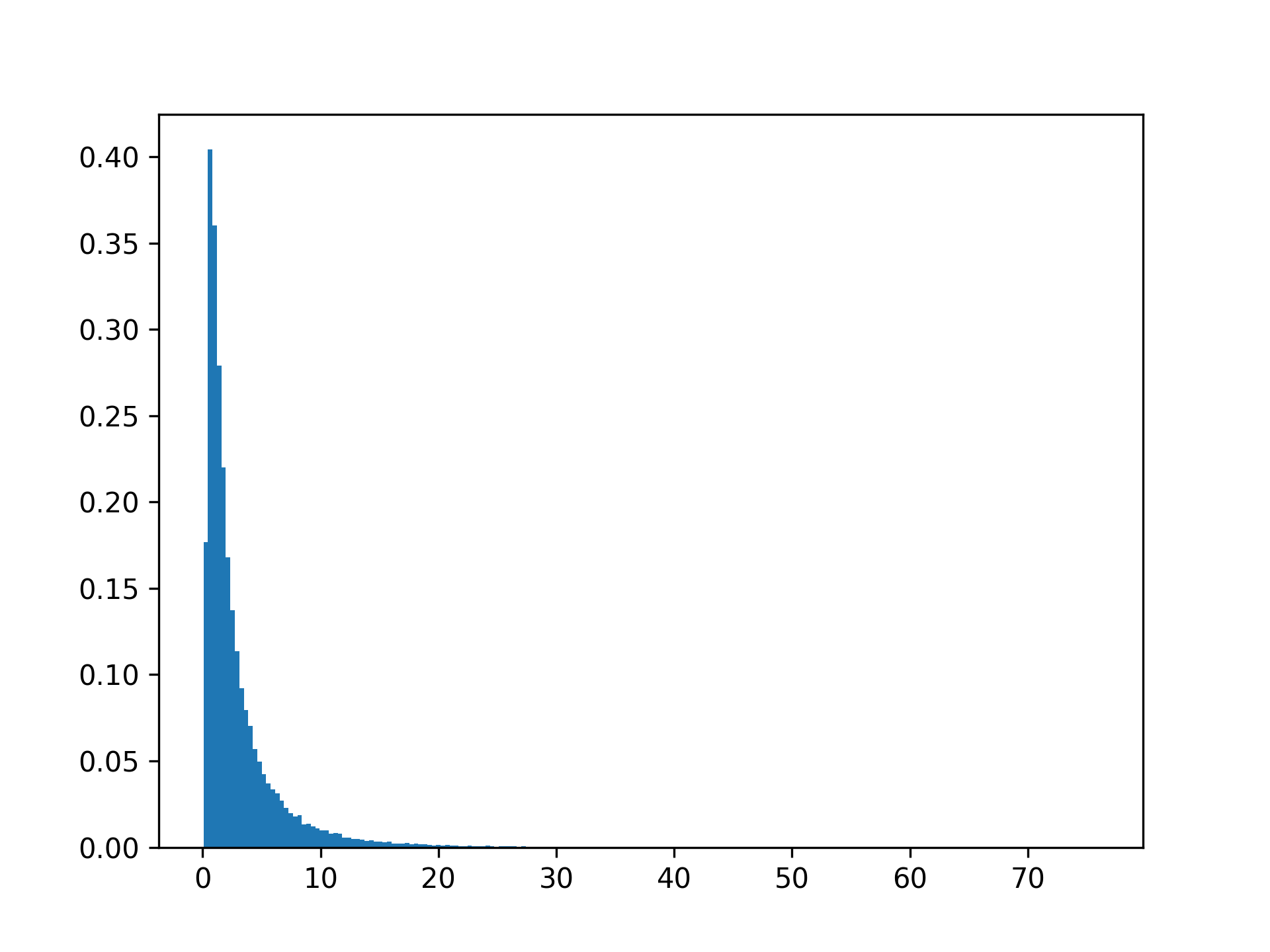
Draw values from the distribution and plot the histogram:import matplotlib.pyplot as plt h = plt.hist(np.random.wald(3, 2, 100000), bins=200, density=True) plt.show()✓
See also
- random.Generator.wald
which should be used for new code.
Aliases
-
numpy.random.wald -
numpy.random.RandomState.wald