bundles / scipy latest / scipy / signal / _filter_design / iircomb
function
scipy.signal._filter_design:iircomb
source: build-install/usr/lib/python3.14/site-packages/scipy/signal/_filter_design.py:5679
Signature
def iircomb(w0, Q, ftype = notch, fs = 2.0, *, pass_zero = False, xp = None, device = None)Summary
Design IIR notching or peaking digital comb filter.
Extended Summary
A notching comb filter consists of regularly-spaced band-stop filters with a narrow bandwidth (high quality factor). Each rejects a narrow frequency band and leaves the rest of the spectrum little changed.
A peaking comb filter consists of regularly-spaced band-pass filters with a narrow bandwidth (high quality factor). Each rejects components outside a narrow frequency band.
Parameters
w0: floatThe fundamental frequency of the comb filter (the spacing between its peaks). This must evenly divide the sampling frequency. If
fsis specified, this is in the same units asfs. By default, it is a normalized scalar that must satisfy0 < w0 < 1, withw0 = 1corresponding to half of the sampling frequency.Q: floatQuality factor. Dimensionless parameter that characterizes notch filter -3 dB bandwidth
bwrelative to its center frequency,Q = w0/bw.ftype: {'notch', 'peak'}The type of comb filter generated by the function. If 'notch', then the Q factor applies to the notches. If 'peak', then the
Qfactor applies to the peaks. Default is 'notch'.fs: float, optionalThe sampling frequency of the signal. Default is 2.0.
pass_zero: bool, optionalIf False (default), the notches (nulls) of the filter are centered on frequencies
[0, w0, 2*w0, ...], and the peaks are centered on the midpoints[w0/2, 3*w0/2, 5*w0/2, ...]. If True, the peaks are centered on[0, w0, 2*w0, ...](passing zero frequency) and vice versa.xp: array_namespace, optionalOptional array namespace. Should be compatible with the array API standard, or supported by array-api-compat. Default:
numpydevice: anyoptional device specification for output. Should match one of the supported device specification in
xp.
Returns
b, a: ndarray, ndarrayNumerator (
b) and denominator (a) polynomials of the IIR filter.
Raises
: ValueErrorIf
w0is less than or equal to 0 or greater than or equal tofs/2, iffsis not divisible byw0, ifftypeis not 'notch' or 'peak'
Notes
For implementation details, see [1]. The TF implementation of the comb filter is numerically stable even at higher orders due to the use of a single repeated pole, which won't suffer from precision loss.
Examples
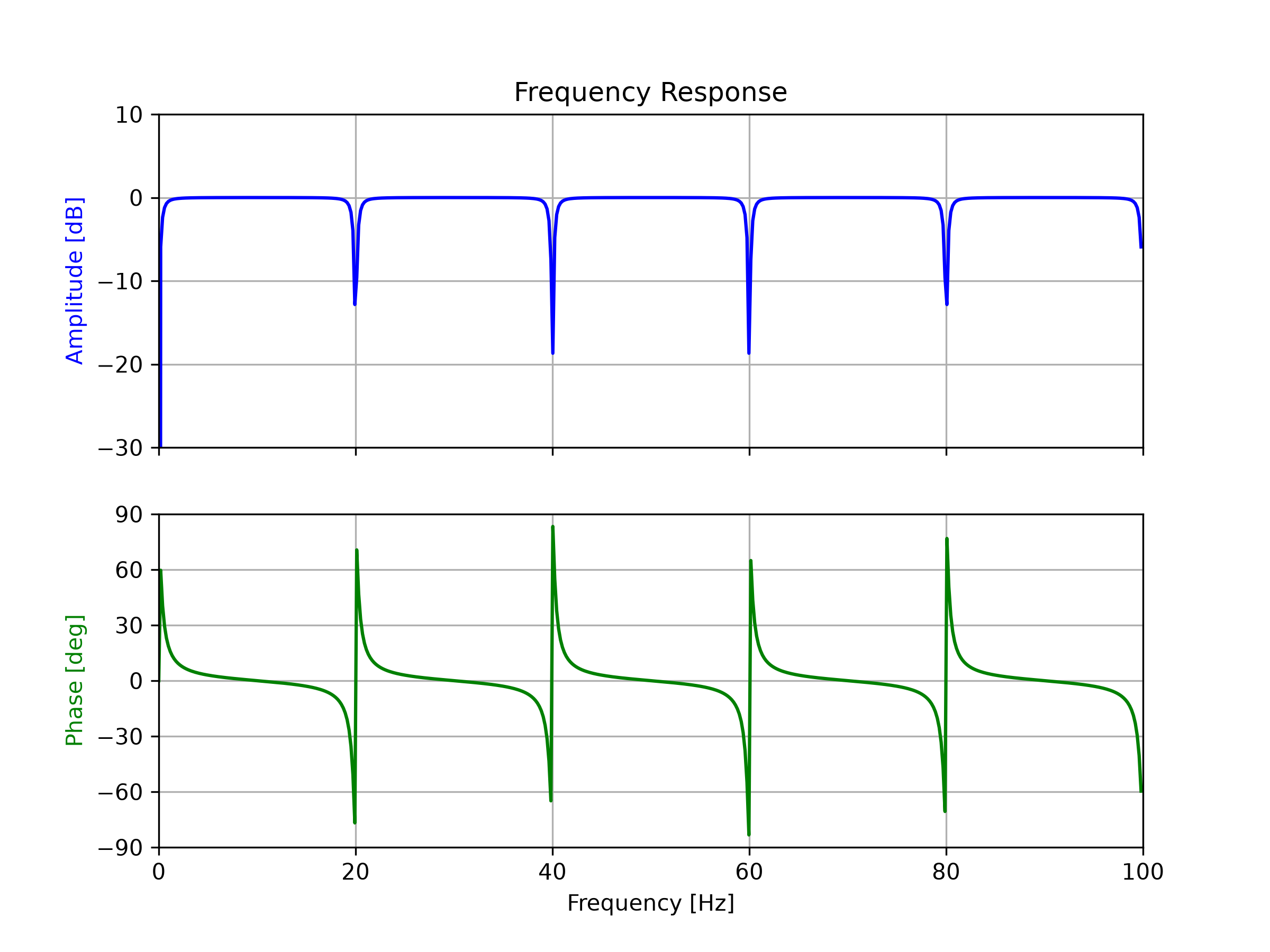
Design and plot notching comb filter at 20 Hz for a signal sampled at 200 Hz, using quality factor Q = 30from scipy import signal import matplotlib.pyplot as plt import numpy as np✓
fs = 200.0  # Sample frequency (Hz)
f0 = 20.0  # Frequency to be removed from signal (Hz)
Q = 30.0  # Quality factor
b, a = signal.iircomb(f0, Q, ftype='notch', fs=fs)
✓
freq, h = signal.freqz(b, a, fs=fs)
response = abs(h)
response[response == 0] = 1e-20
fig, ax = plt.subplots(2, 1, figsize=(8, 6), sharex=True)
✓
ax[0].plot(freq, 20*np.log10(abs(response)), color='blue')
ax[0].set_title("Frequency Response")
ax[0].set_ylabel("Amplitude [dB]", color='blue')
ax[0].set_xlim([0, 100])
ax[0].set_ylim([-30, 10])
✗
(-30.0, 10.0)
ax[0].grid(True)
✓ax[1].plot(freq, np.mod(np.angle(h, deg=True) + 180, 360) - 180, color='green') ax[1].set_ylabel("Phase [deg]", color='green') ax[1].set_xlabel("Frequency [Hz]") ax[1].set_xlim([0, 100]) ax[1].set_yticks([-90, -60, -30, 0, 30, 60, 90]) ax[1].set_ylim([-90, 90])✗
(-90.0, 90.0)
ax[1].grid(True)
plt.show()
✓
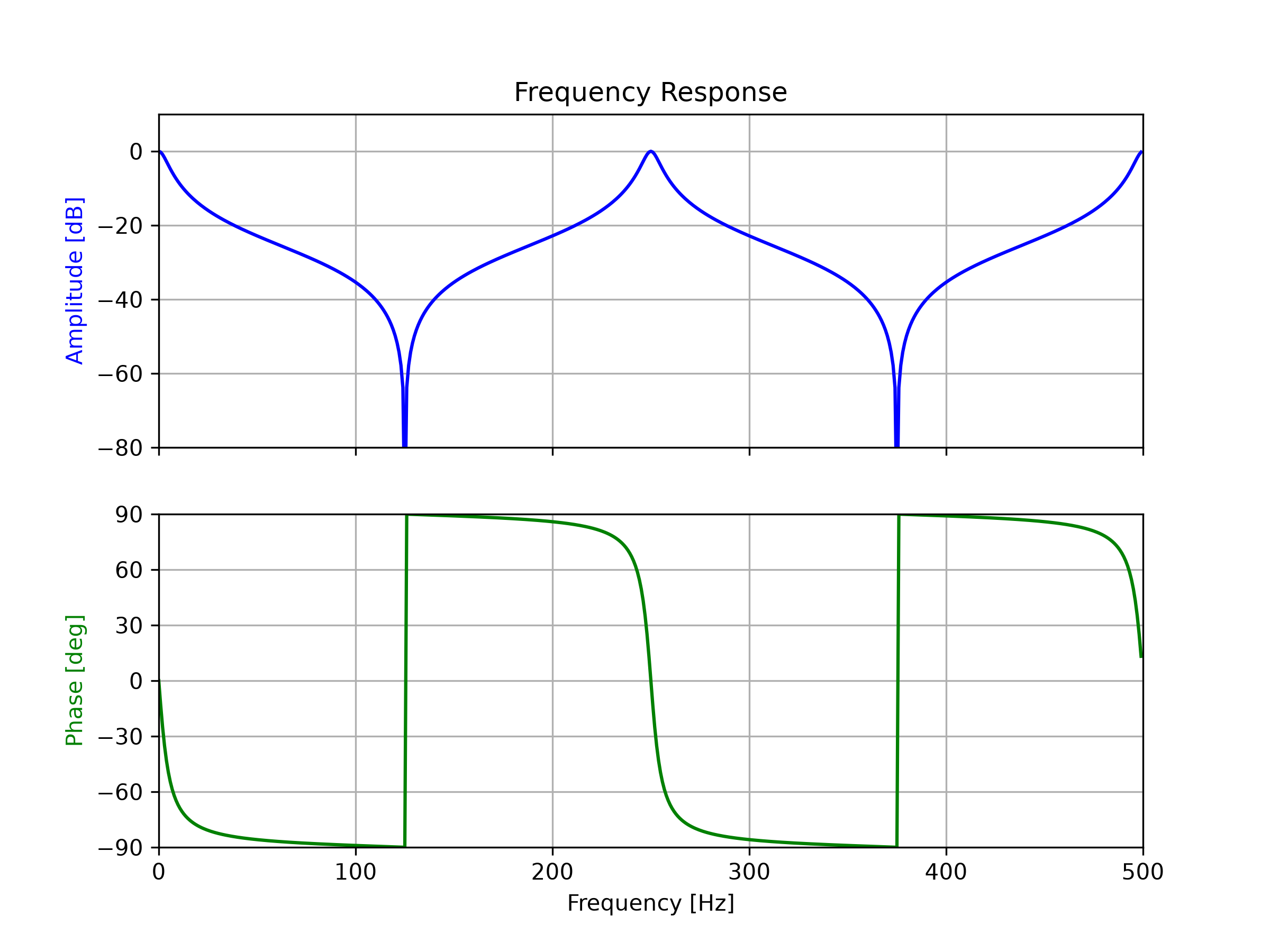
fs = 1000.0  # Sample frequency (Hz)
f0 = 250.0  # Frequency to be retained (Hz)
Q = 30.0  # Quality factor
b, a = signal.iircomb(f0, Q, ftype='peak', fs=fs, pass_zero=True)
✓
freq, h = signal.freqz(b, a, fs=fs)
response = abs(h)
response[response == 0] = 1e-20
fig, ax = plt.subplots(2, 1, figsize=(8, 6), sharex=True)
✓
ax[0].plot(freq, 20*np.log10(np.maximum(abs(h), 1e-5)), color='blue')
ax[0].set_title("Frequency Response")
ax[0].set_ylabel("Amplitude [dB]", color='blue')
ax[0].set_xlim([0, 500])
ax[0].set_ylim([-80, 10])
✗
(-80.0, 10.0)
ax[0].grid(True)
✓ax[1].plot(freq, np.mod(np.angle(h)*180/np.pi + 180, 360) - 180, color='green') ax[1].set_ylabel("Phase [deg]", color='green') ax[1].set_xlabel("Frequency [Hz]") ax[1].set_xlim([0, 500]) ax[1].set_yticks([-90, -60, -30, 0, 30, 60, 90]) ax[1].set_ylim([-90, 90])✗
(-90.0, 90.0)
ax[1].grid(True)
plt.show()
✓
See also
Aliases
scipy.signal.iircomb