bundles / numpy latest / numpy / random / _generator / Generator / multivariate_normal
cython_function_or_method
numpy.random._generator:Generator.multivariate_normal
Signature
def multivariate_normal(mean, cov, size = None, check_valid = warn, tol = 1e-08, *, method = svd)Summary
Draw random samples from a multivariate normal distribution.
Extended Summary
The multivariate normal, multinormal or Gaussian distribution is a generalization of the one-dimensional normal distribution to higher dimensions. Such a distribution is specified by its mean and covariance matrix. These parameters are analogous to the mean (average or "center") and variance (the squared standard deviation, or "width") of the one-dimensional normal distribution.
Parameters
mean: 1-D array_like, of length NMean of the N-dimensional distribution.
cov: 2-D array_like, of shape (N, N)Covariance matrix of the distribution. It must be symmetric and positive-semidefinite for proper sampling.
size: int or tuple of ints, optionalGiven a shape of, for example,
(m,n,k),m*n*ksamples are generated, and packed in anm-by-n-by-karrangement. Because each sample isN-dimensional, the output shape is(m,n,k,N). If no shape is specified, a single (N-D) sample is returned.check_valid: { 'warn', 'raise', 'ignore' }, optionalBehavior when the covariance matrix is not positive semidefinite.
tol: float, optionalTolerance when checking the singular values in covariance matrix. cov is cast to double before the check.
method: { 'svd', 'eigh', 'cholesky'}, optionalThe cov input is used to compute a factor matrix A such that
A @ A.T = cov. This argument is used to select the method used to compute the factor matrix A. The default method 'svd' is the slowest, while 'cholesky' is the fastest but less robust than the slowest method. The method eigh uses eigen decomposition to compute A and is faster than svd but slower than cholesky.
Returns
out: ndarrayThe drawn samples, of shape size, if that was provided. If not, the shape is
(N,).In other words, each entry
out[i,j,...,:]is an N-dimensional value drawn from the distribution.
Notes
The mean is a coordinate in N-dimensional space, which represents the location where samples are most likely to be generated. This is analogous to the peak of the bell curve for the one-dimensional or univariate normal distribution.
Covariance indicates the level to which two variables vary together. From the multivariate normal distribution, we draw N-dimensional samples, . The covariance matrix element is the covariance of and . The element is the variance of (i.e. its "spread").
Instead of specifying the full covariance matrix, popular approximations include:
Spherical covariance (
covis a multiple of the identity matrix)Diagonal covariance (
covhas non-negative elements, and only on the diagonal)
This geometrical property can be seen in two dimensions by plotting generated data-points:
>>> mean = [0, 0]
>>> cov = [[1, 0], [0, 100]]  # diagonal covariance
Diagonal covariance means that the variables are independent, and the probability density contours have their axes aligned with the coordinate axes:
>>> import matplotlib.pyplot as plt
>>> rng = np.random.default_rng()
>>> x, y = rng.multivariate_normal(mean, cov, 5000).T
>>> plt.plot(x, y, 'x')
>>> plt.axis('equal')
>>> plt.show()
Note that the covariance matrix must be positive semidefinite (a.k.a. nonnegative-definite). Otherwise, the behavior of this method is undefined and backwards compatibility is not guaranteed.
This function internally uses linear algebra routines, and thus results may not be identical (even up to precision) across architectures, OSes, or even builds. For example, this is likely if cov has multiple equal singular values and method is 'svd' (default). In this case, method='cholesky' may be more robust.
Examples
mean = (1, 2)
cov = [[1, 0], [0, 1]]
rng = np.random.default_rng()
x = rng.multivariate_normal(mean, cov, (3, 3))
x.shape
✓
(3, 3, 2)We can use a different method other than the default to factorize cov:
y = rng.multivariate_normal(mean, cov, (3, 3), method='cholesky')
y.shape
✓
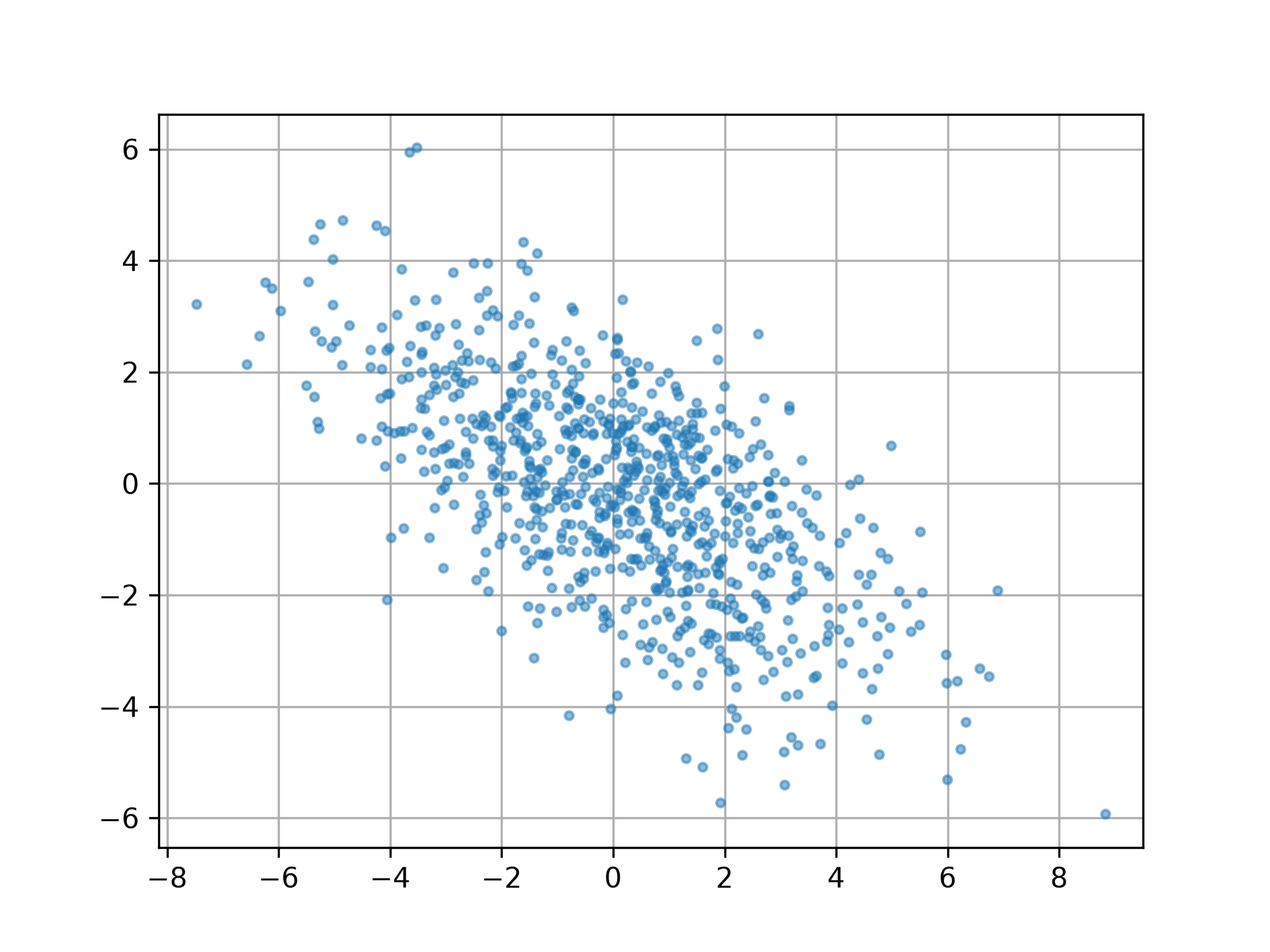
(3, 3, 2)Here we generate 800 samples from the bivariate normal distribution with mean [0, 0] and covariance matrix [[6, -3], [-3, 3.5]]. The expected variances of the first and second components of the sample are 6 and 3.5, respectively, and the expected correlation coefficient is -3/sqrt(6*3.5) ≈ -0.65465.
cov = np.array([[6, -3], [-3, 3.5]])
pts = rng.multivariate_normal([0, 0], cov, size=800)
✓
pts.mean(axis=0)
np.cov(pts.T)
np.corrcoef(pts.T)[0, 1]
✗
np.float64(-0.6275249005033223)We can visualize this data with a scatter plot. The orientation of the point cloud illustrates the negative correlation of the components of this sample.
import matplotlib.pyplot as plt
✓plt.plot(pts[:, 0], pts[:, 1], '.', alpha=0.5) plt.axis('equal')✗
(np.float64(-8.285907739499422), np.float64(9.63885654985727), np.float64(-6.527562776502569), np.float64(6.626238623088667))
plt.grid()
plt.show()
✓
Aliases
numpy.random.Generator.multivariate_normal