bundles / scipy latest / scipy / signal / _signaltools / correlate
function
scipy.signal._signaltools:correlate
source: build-install/usr/lib/python3.14/site-packages/scipy/signal/_signaltools.py:101
Signature
def correlate(in1, in2, mode = full, method = auto)Summary
Cross-correlate two N-dimensional arrays.
Extended Summary
Cross-correlate in1 and in2, with the output size determined by the mode argument.
Parameters
in1: array_likeFirst input.
in2: array_likeSecond input. Should have the same number of dimensions as
in1.mode: str {'full', 'valid', 'same'}, optionalA string indicating the size of the output:
fullThe output is the full discrete linear cross-correlation of the inputs. (Default)
validThe output consists only of those elements that do not rely on the zero-padding. In 'valid' mode, either
in1orin2must be at least as large as the other in every dimension.sameOutput size will be
N, the same size asin1, centered with respect to the 'full' output. Boundary effects may be visible.
method: str {'auto', 'direct', 'fft'}, optionalA string indicating which method to use to calculate the correlation.
directThe correlation is determined directly from sums, the definition of correlation.
fftThe Fast Fourier Transform is used to perform the correlation more quickly (only available for numerical arrays.)
autoAutomatically chooses direct or Fourier method based on an estimate of which is faster (default). See convolve Notes for more detail.
Returns
correlate: arrayAn N-dimensional array containing a subset of the discrete linear cross-correlation of
in1within2.
Notes
The correlation z of two d-dimensional arrays x and y is defined as
z[...,k,...] = sum[..., i_l, ...] x[..., i_l,...] * conj(y[..., i_l - k,...])This way, if x and y are 1-D arrays and z = correlate(x, y, 'full') then
for , where is the length of x, is the length of y, and when is outside the valid range . The size of is and denotes the complex conjugate of .
method='fft' only works for numerical arrays as it relies on fftconvolve. In certain cases (i.e., arrays of objects or when rounding integers can lose precision), method='direct' is always used.
When using mode='same' with even-length inputs, the outputs of correlate and correlate2d differ: There is a 1-index offset between them.
Examples
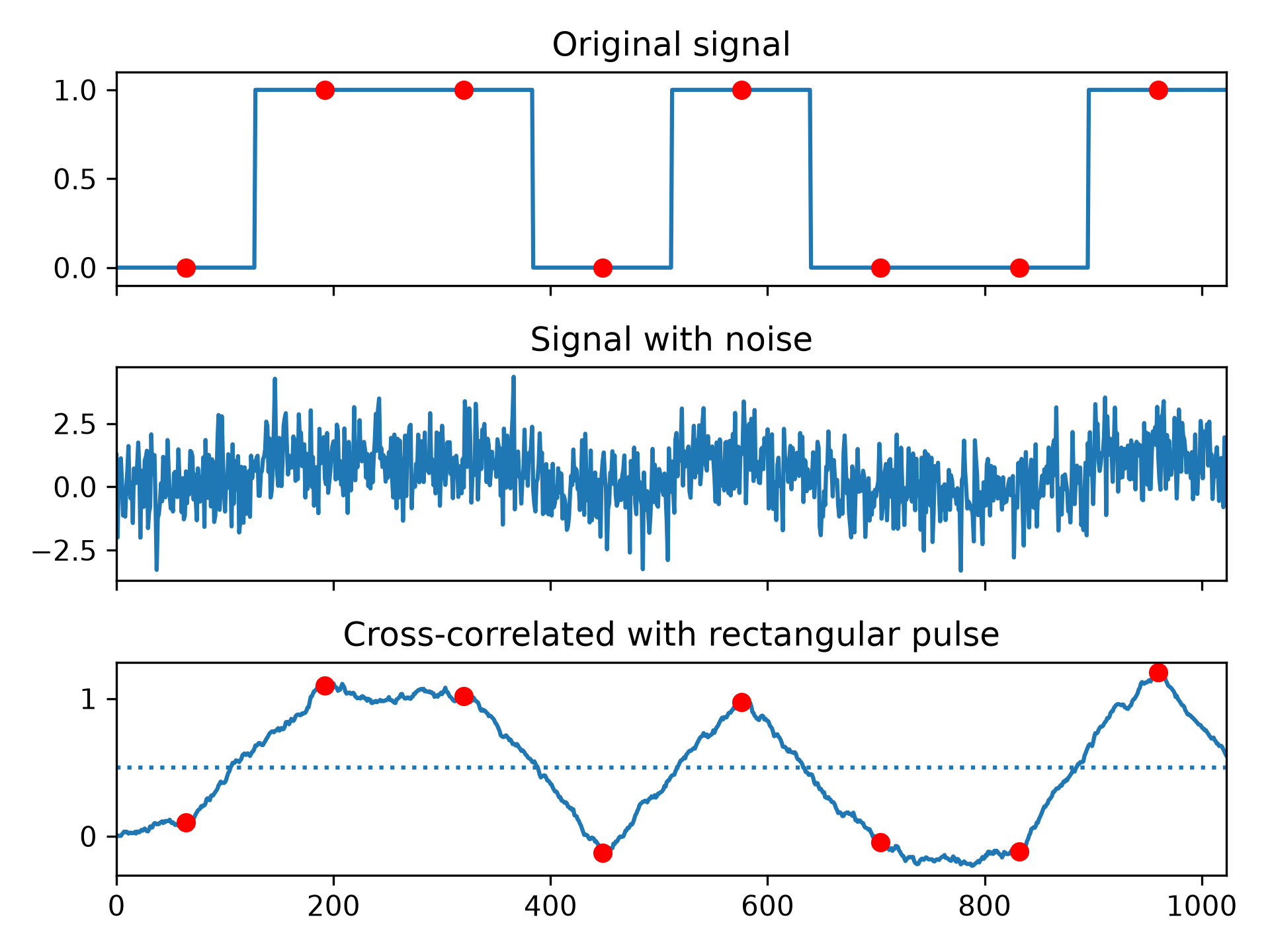
Implement a matched filter using cross-correlation, to recover a signal that has passed through a noisy channel.import numpy as np from scipy import signal import matplotlib.pyplot as plt rng = np.random.default_rng()✓
sig = np.repeat([0., 1., 1., 0., 1., 0., 0., 1.], 128)
sig_noise = sig + rng.standard_normal(len(sig))
corr = signal.correlate(sig_noise, np.ones(128), mode='same') / 128
✓
clock = np.arange(64, len(sig), 128)
fig, (ax_orig, ax_noise, ax_corr) = plt.subplots(3, 1, sharex=True)
✓
ax_orig.plot(sig)
ax_orig.plot(clock, sig[clock], 'ro')
ax_orig.set_title('Original signal')
ax_noise.plot(sig_noise)
ax_noise.set_title('Signal with noise')
ax_corr.plot(corr)
ax_corr.plot(clock, corr[clock], 'ro')
ax_corr.axhline(0.5, ls=':')
ax_corr.set_title('Cross-correlated with rectangular pulse')
✗
Text(0.5, 1.0, 'Cross-correlated with rectangular pulse')
ax_orig.margins(0, 0.1)
fig.tight_layout()
plt.show()
✓
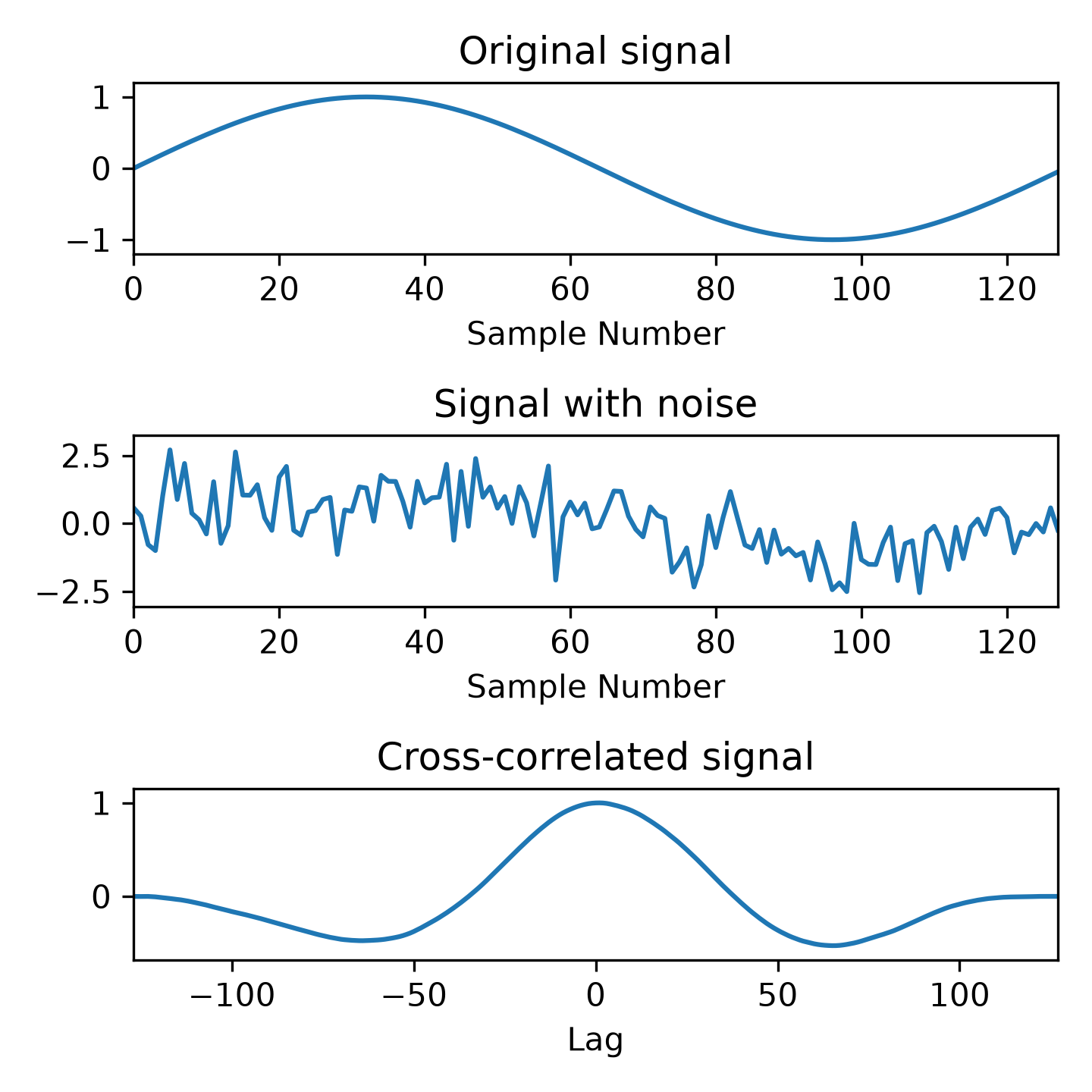
x = np.arange(128) / 128
sig = np.sin(2 * np.pi * x)
sig_noise = sig + rng.standard_normal(len(sig))
corr = signal.correlate(sig_noise, sig)
lags = signal.correlation_lags(len(sig), len(sig_noise))
corr /= np.max(corr)
✓
fig, (ax_orig, ax_noise, ax_corr) = plt.subplots(3, 1, figsize=(4.8, 4.8))
✓ax_orig.plot(sig) ax_orig.set_title('Original signal') ax_orig.set_xlabel('Sample Number') ax_noise.plot(sig_noise) ax_noise.set_title('Signal with noise') ax_noise.set_xlabel('Sample Number') ax_corr.plot(lags, corr) ax_corr.set_title('Cross-correlated signal') ax_corr.set_xlabel('Lag')✗
Text(0.5, 0, 'Lag')
ax_orig.margins(0, 0.1)
ax_noise.margins(0, 0.1)
ax_corr.margins(0, 0.1)
fig.tight_layout()
plt.show()
✓
See also
- choose_conv_method
contains more documentation on
method.- correlation_lags
calculates the lag / displacement indices array for 1D cross-correlation.
Aliases
scipy.signal.correlate
Referenced by
Other packages
- numpynumpy:correlate