bundles / scipy latest / scipy / signal / _signaltools / detrend
function
scipy.signal._signaltools:detrend
source: build-install/usr/lib/python3.14/site-packages/scipy/signal/_signaltools.py:4367
Signature
def detrend(data: np.ndarray, axis: int = -1, type: Literal['linear', 'constant'] = linear, bp: ArrayLike | int = 0, overwrite_data: bool = False) → np.ndarraySummary
Remove linear or constant trend along axis from data.
Parameters
data: array_likeThe input data.
axis: int, optionalThe axis along which to detrend the data. By default this is the last axis (-1).
type: {'linear', 'constant'}, optionalThe type of detrending. If
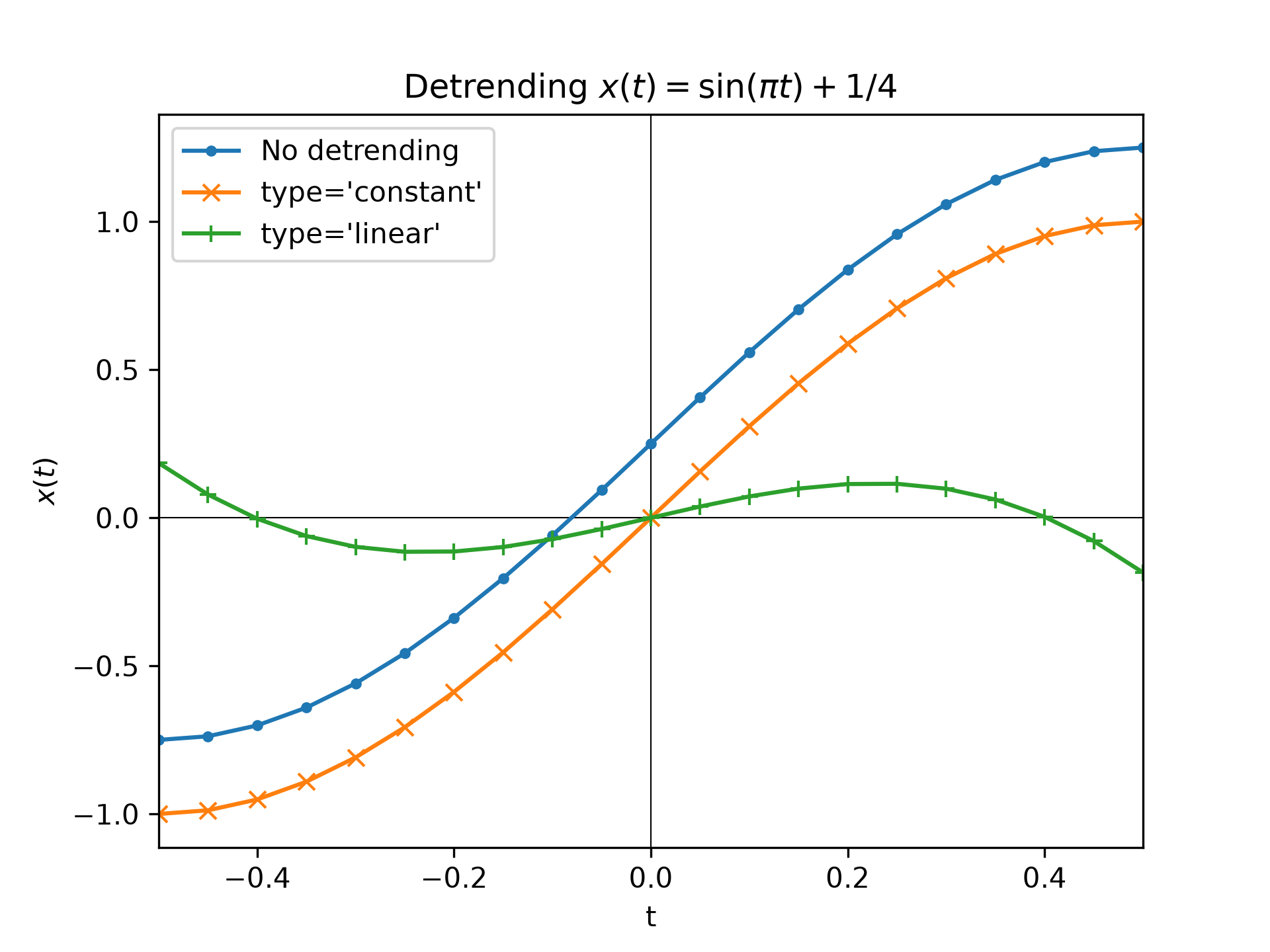
type == 'linear'(default), the result of a linear least-squares fit todatais subtracted fromdata. Iftype == 'constant', only the mean ofdatais subtracted.bp: array_like of ints, optionalA sequence of break points. If given, an individual linear fit is performed for each part of
databetween two break points. Break points are specified as indices intodata. This parameter only has an effect whentype == 'linear'.overwrite_data: bool, optionalIf True, allow in place detrending and avoid a copy. Default is False. In place modification applies only if
type == 'linear'anddatais of the floating point dtypefloat32,float64,complex64orcomplex128.
Returns
ret: ndarrayThe detrended input data.
Notes
Detrending can be interpreted as subtracting a least squares fit polynomial: Setting the parameter type to 'constant' corresponds to fitting a zeroth degree polynomial, 'linear' to a first degree polynomial. Consult the example below.
Examples
The following example detrends the function :math:`x(t) = \sin(\pi t) + 1/4`:import matplotlib.pyplot as plt import numpy as np from scipy.signal import detrend t = np.linspace(-0.5, 0.5, 21) x = np.sin(np.pi*t) + 1/4 x_d_const = detrend(x, type='constant') x_d_linear = detrend(x, type='linear') fig1, ax1 = plt.subplots()✓
ax1.set_title(r"Detrending $x(t)=\sin(\pi t) + 1/4$")
ax1.set(xlabel="t", ylabel="$x(t)$", xlim=(t[0], t[-1]))
ax1.axhline(y=0, color='black', linewidth=.5)
ax1.axvline(x=0, color='black', linewidth=.5)
ax1.plot(t, x, 'C0.-',  label="No detrending")
ax1.plot(t, x_d_const, 'C1x-', label="type='constant'")
ax1.plot(t, x_d_linear, 'C2+-', label="type='linear'")
ax1.legend()
✗
<matplotlib.legend.Legend object at 0x7f3f686357f0>
plt.show()
✓
pp0 = np.polynomial.Polynomial.fit(t, x, deg=0)  # fit degree 0 polynomial
np.allclose(x_d_const, x - pp0(t))  # compare with constant detrend
pp1 = np.polynomial.Polynomial.fit(t, x, deg=1)  # fit degree 1 polynomial
np.allclose(x_d_linear, x - pp1(t))  # compare with linear detrend
✓
TrueNote that `~numpy.polynomial.polynomial.Polynomial` also allows fitting higher degree polynomials. Consult its documentation on how to extract the polynomial coefficients.
See also
- numpy.polynomial.polynomial.Polynomial.fit
Create least squares fit polynomial.
Aliases
scipy.signal.detrend