bundles / scipy latest / scipy / signal / _signaltools / envelope
function
scipy.signal._signaltools:envelope
source: build-install/usr/lib/python3.14/site-packages/scipy/signal/_signaltools.py:2782
Signature
def envelope(z, bp_in: tuple[int | None, int | None] = (1, None), *, n_out: int | None = None, squared: bool = False, residual: Literal['lowpass', 'all', None] = lowpass, axis: int = -1)Summary
Compute the envelope of a real- or complex-valued signal.
Parameters
z: ndarrayReal- or complex-valued input signal, which is assumed to be made up of
nsamples and having sampling intervalT.zmay also be a multidimensional array with the time axis being defined byaxis.bp_in: tuple[int | None, int | None], optional2-tuple defining the frequency band
bp_in[0]:bp_in[1]of the input filter. The corner frequencies are specified as integer multiples of1/(n*T)with-n//2 <= bp_in[0] < bp_in[1] <= (n+1)//2being the allowed frequency range.Noneentries are replaced with-n//2or(n+1)//2respectively. The default of(1, None)removes the mean value as well as the negative frequency components.n_out: int | None, optionalIf not
Nonethe output will be resampled ton_outsamples. The default ofNonesets the output to the same length as the inputz.squared: bool, optionalIf set, the square of the envelope is returned. The bandwidth of the squared envelope is often smaller than the non-squared envelope bandwidth due to the nonlinear nature of the utilized absolute value function. I.e., the embedded square root function typically produces addiational harmonics. The default is
False.residual: Literal['lowpass', 'all', None], optionalThis option determines what kind of residual, i.e., the signal part which the input bandpass filter removes, is returned.
'all'returns everything except the contents of the frequency bandbp_in[0]:bp_in[1],'lowpass'returns the contents of the frequency band< bp_in[0]. IfNonethen only the envelope is returned. Default:'lowpass'.axis: int, optionalAxis of
zover which to compute the envelope. Default is last the axis.
Returns
: ndarrayIf parameter
residualisNonethen an arrayz_envwith the same shape as the inputzis returned, containing its envelope. Otherwise, an array with shape(2, *z.shape), containing the arraysz_envandz_res, stacked along the first axis, is returned. It allows unpacking, i.e.,z_env, z_res = envelope(z, residual='all'). The residualz_rescontains the signal part which the input bandpass filter removed, depending on the parameterresidual. Note that for real-valued signals, a real-valued residual is returned. Hence, the negative frequency components ofbp_inare ignored.
Notes
Any complex-valued signal can be described by a real-valued instantaneous amplitude and a real-valued instantaneous phase , i.e., . The envelope is defined as the absolute value of the amplitude , which is at the same time the absolute value of the signal. Hence, "envelopes" the class of all signals with amplitude and arbitrary phase . For real-valued signals, is the analogous formulation. Hence, can be determined by converting into an analytic signal by means of a Hilbert transform, i.e., , which produces a complex-valued signal with the same envelope .
The implementation is based on computing the FFT of the input signal and then performing the necessary operations in Fourier space. Hence, the typical FFT caveats need to be taken into account. The frequency spacing 1 / (n*T) for corner frequencies of the bandpass filter corresponds to the frequencies produced by scipy.fft.fftfreq(len(z), T).
If the envelope of a complex-valued signal z with no bandpass filtering is desired, i.e., bp_in=(None, None), then the envelope corresponds to the absolute value. Hence, it is more efficient to use np.abs(z) instead of this function.
Although computing the envelope based on the analytic signal [1] is the natural method for real-valued signals, other methods are also frequently used. The most popular alternative is probably the so-called "square-law" envelope detector and its relatives [2]. They do not always compute the correct result for all kinds of signals, but are usually correct and typically computationally more efficient for most kinds of narrowband signals. The definition for an envelope presented here is common where instantaneous amplitude and phase are of interest (e.g., as described in [3]). There exist also other concepts, which rely on the general mathematical idea of an envelope [4]: A pragmatic approach is to determine all upper and lower signal peaks and use a spline interpolation to determine the curves [5].
Examples
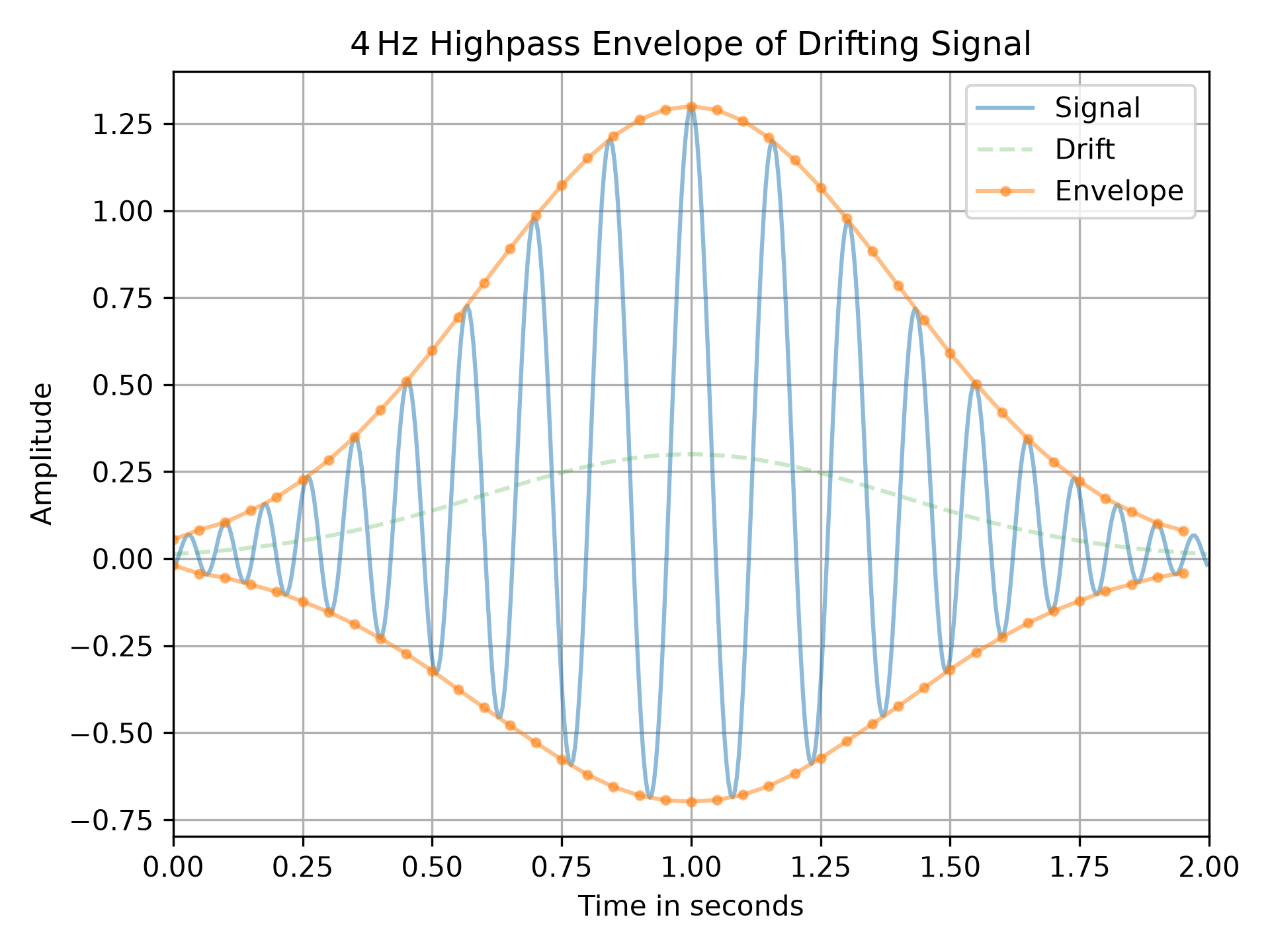
The following plot illustrates the envelope of a signal with variable frequency and a low-frequency drift. To separate the drift from the envelope, a 4 Hz highpass filter is used. The low-pass residuum of the input bandpass filter is utilized to determine an asymmetric upper and lower bound to enclose the signal. Due to the smoothness of the resulting envelope, it is down-sampled from 500 to 40 samples. Note that the instantaneous amplitude ``a_x`` and the computed envelope ``x_env`` are not perfectly identical. This is due to the signal not being perfectly periodic as well as the existence of some spectral overlapping of ``x_carrier`` and ``x_drift``. Hence, they cannot be completely separated by a bandpass filter.import matplotlib.pyplot as plt import numpy as np from scipy.signal.windows import gaussian from scipy.signal import envelope n, n_out = 500, 40 # number of signal samples and envelope samples T = 2 / n # sampling interval for 2 s duration t = np.arange(n) * T # time stamps a_x = gaussian(len(t), 0.4/T) # instantaneous amplitude phi_x = 30*np.pi*t + 35*np.cos(2*np.pi*0.25*t) # instantaneous phase x_carrier = a_x * np.cos(phi_x) x_drift = 0.3 * gaussian(len(t), 0.4/T) # drift x = x_carrier + x_drift bp_in = (int(4 * (n*T)), None) # 4 Hz highpass input filter x_env, x_res = envelope(x, bp_in, n_out=n_out) t_out = np.arange(n_out) * (n / n_out) * T fg0, ax0 = plt.subplots(1, 1, tight_layout=True)✓
ax0.set_title(r"$4\,$Hz Highpass Envelope of Drifting Signal")
ax0.set(xlabel="Time in seconds", xlim=(0, n*T), ylabel="Amplitude")
ax0.plot(t, x, 'C0-', alpha=0.5, label="Signal")
ax0.plot(t, x_drift, 'C2--', alpha=0.25, label="Drift")
ax0.plot(t_out, x_res+x_env, 'C1.-', alpha=0.5, label="Envelope")
ax0.plot(t_out, x_res-x_env, 'C1.-', alpha=0.5, label=None)
✗
[<matplotlib.lines.Line2D object at 0x7f3f69118ad0>]
ax0.grid(True)
✓ax0.legend()
✗<matplotlib.legend.Legend object at 0x7f3f69118c20>
plt.show()
✓
import matplotlib.pyplot as plt
import numpy as np
from scipy.signal.windows import gaussian
from scipy.signal import envelope
n, T = 1000, 1/1000  # number of samples and sampling interval
t = np.arange(n) * T  # time stamps for 1 s duration
f_c = 3  # Carrier frequency for signal
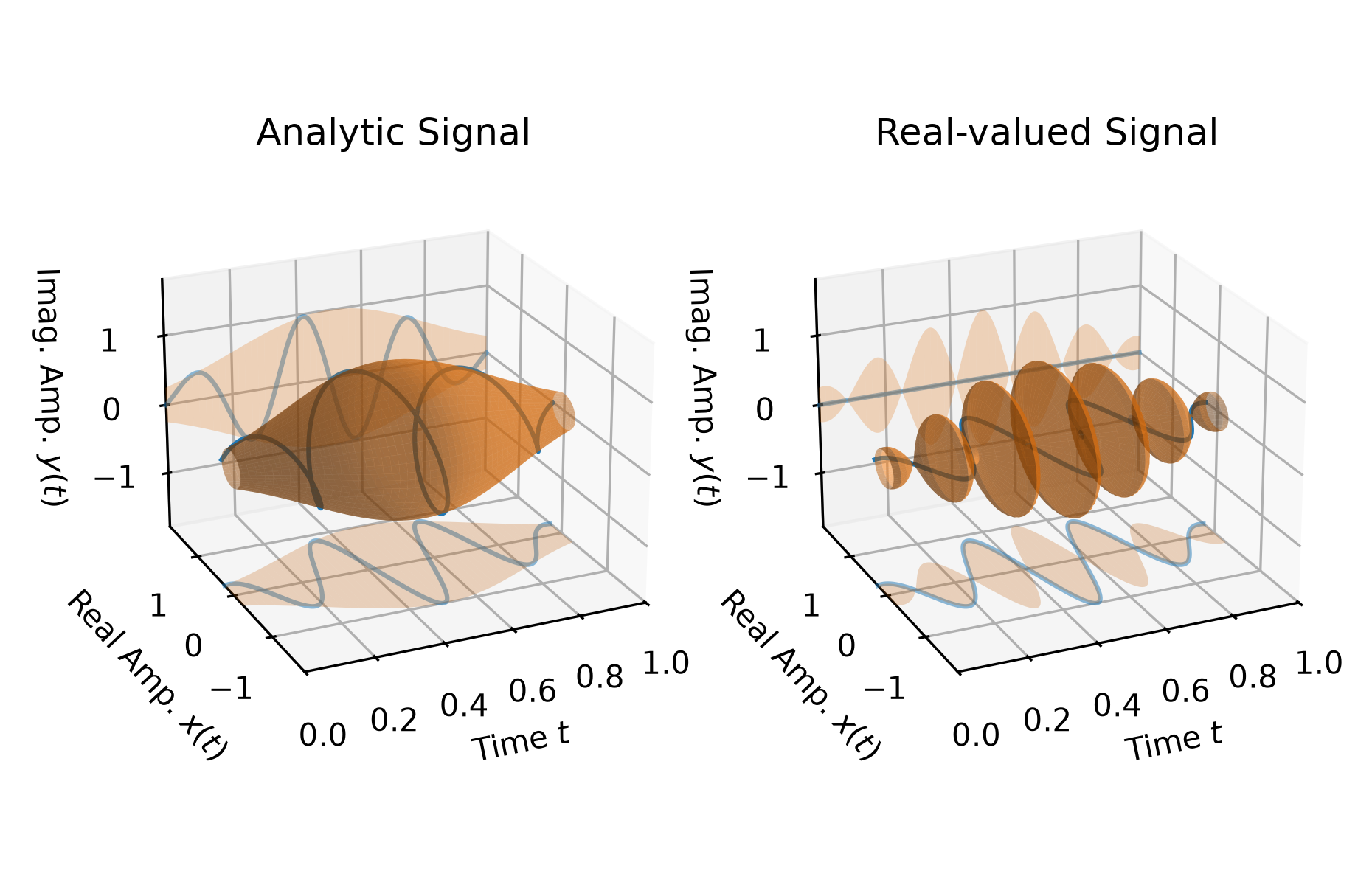
z = gaussian(len(t), 0.3/T) * np.exp(2j*np.pi*f_c*t)  # analytic signal
z_re = z.real + 0j  # complex signal with zero imaginary part
e_a, e_r = (envelope(z_, (None, None), residual=None) for z_ in (z, z_re))
E2d_t, E2_amp = np.meshgrid(t, [-1, 1])
E2d_1 = np.ones_like(E2_amp)
E3d_t, E3d_phi = np.meshgrid(t, np.linspace(-np.pi, np.pi, 300))
ma = 1.8  # maximum axis values in real and imaginary direction
fg0 = plt.figure(figsize=(6.2, 4.))
ax00 = fg0.add_subplot(1, 2, 1, projection='3d')
ax01 = fg0.add_subplot(1, 2, 2, projection='3d', sharex=ax00,
                       sharey=ax00, sharez=ax00)
✓
ax00.set_title("Analytic Signal")
ax00.set(xlim=(0, 1), ylim=(-ma, ma), zlim=(-ma, ma))
ax01.set_title("Real-valued Signal")
for z_, e_, ax_ in zip((z, z.real), (e_a, e_r), (ax00, ax01)):
    ax_.set(xlabel="Time $t$", ylabel="Real Amp. $x(t)$",
            zlabel="Imag. Amp. $y(t)$")
    ax_.plot(t, z_.real, 'C0-', zs=-ma, zdir='z', alpha=0.5, label="Real")
    ax_.plot_surface(E2d_t, e_*E2_amp, -ma*E2d_1, color='C1', alpha=0.25)
    ax_.plot(t, z_.imag, 'C0-', zs=+ma, zdir='y', alpha=0.5, label="Imag.")
    ax_.plot_surface(E2d_t, ma*E2d_1, e_*E2_amp, color='C1', alpha=0.25)
    ax_.plot(t, z_.real, z_.imag, 'C0-', label="Signal")
    ax_.plot_surface(E3d_t, e_*np.cos(E3d_phi), e_*np.sin(E3d_phi),
                     color='C1', alpha=0.5, shade=True, label="Envelope")
    ax_.view_init(elev=22.7, azim=-114.3)
✗
[Text(0.5, 0, 'Time $t$'), Text(0.5, 0.5, 'Real Amp. $x(t)$'), Text(0.5, 0, 'Imag. Amp. $y(t)$')]
[<mpl_toolkits.mplot3d.art3d.Line3D object at 0x7f3f60316cf0>]
<mpl_toolkits.mplot3d.art3d.Poly3DCollection object at 0x7f3f60316a50>
[<mpl_toolkits.mplot3d.art3d.Line3D object at 0x7f3f60314440>]
<mpl_toolkits.mplot3d.art3d.Poly3DCollection object at 0x7f3f68d6d950>
[<mpl_toolkits.mplot3d.art3d.Line3D object at 0x7f3f60314980>]
<mpl_toolkits.mplot3d.art3d.Poly3DCollection object at 0x7f3f68d6d450>
[Text(0.5, 0, 'Time $t$'), Text(0.5, 0.5, 'Real Amp. $x(t)$'), Text(0.5, 0, 'Imag. Amp. $y(t)$')]
[<mpl_toolkits.mplot3d.art3d.Line3D object at 0x7f3f603141a0>]
<mpl_toolkits.mplot3d.art3d.Poly3DCollection object at 0x7f3f68d6cf50>
[<mpl_toolkits.mplot3d.art3d.Line3D object at 0x7f3f60317cb0>]
<mpl_toolkits.mplot3d.art3d.Poly3DCollection object at 0x7f3f68d6c7d0>
[<mpl_toolkits.mplot3d.art3d.Line3D object at 0x7f3f60317e00>]
<mpl_toolkits.mplot3d.art3d.Poly3DCollection object at 0x7f3f68d6dd10>
fg0.subplots_adjust(left=0.08, right=0.97, wspace=0.15)
plt.show()
✓
See also
- hilbert
Compute analytic signal by means of Hilbert transform.
Aliases
scipy.signal.envelope